ZeroAvia
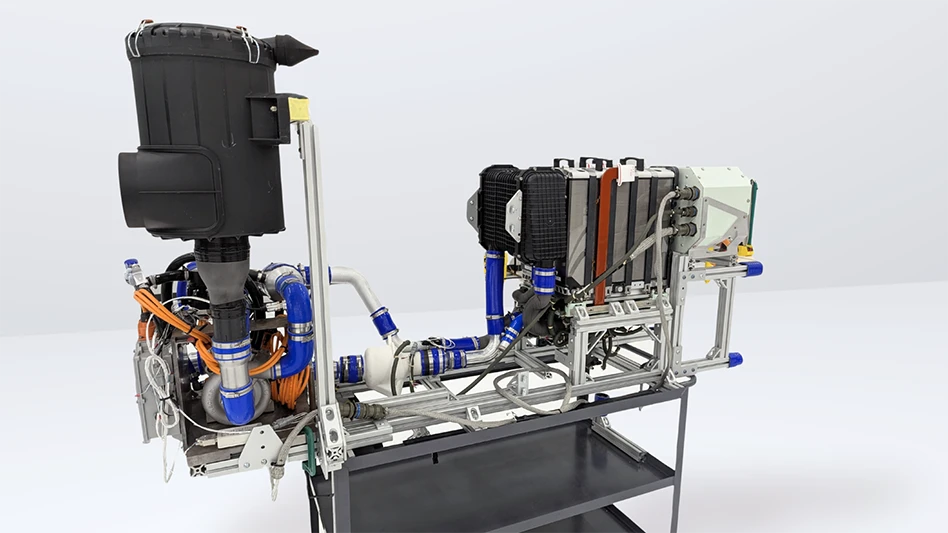
ZeroAvia has shipped its first fully qualified flight intent SuperStack Flex modular low temperature proton exchange membrane (LTPEM) fuel cell system to a customer in the defense sector. The system has been fully qualified against the customer’s airworthiness requirements.
ZeroAvia’s SuperStack Flex is a modular fuel cell power generation system that can be configured to meet specific customer power needs while maintaining high power-to-weight ratio and highly flexible configuration.
The lightweight, aerospace optimized balance-of-plant, has been developed to enhance the range of many unmanned air vehicles (UAV), with further potential applicability across aerospace, maritime and ground use cases. The system can be used to provide propulsive power or to deliver enhanced onboard electrical capacity, opening new capabilities in primary propulsion, auxiliary power systems and mission systems including ISR applications. The Superstack Flex is also an ideal system for the new FAA Mosaic Light Sport Category, providing more than enough power for a standard four-seater general aviation (GA) aircraft in this sector.
The SuperStack Flex has demonstrated over 1.2kW/kg specific power and recently completed more than 100 hours of ground testing, consuming over 250kg of hydrogen, and delivering continuous power at greater than 150kW over long intervals, with peak power over 175kW.
Hydrogen and fuel cell technologies are becoming increasingly relevant to armed forces due to unique advantages in energy density, lower detectability thanks to reduced thermal and noise signatures, operational flexibility and lower maintenance costs.
Using selective laser sintering (SLS) powder-bed additive manufacturing processes, ZeroAvia has been able to perform high velocity cycles of design, build and test, and quickly combine typical parts or their functions into new monolithic structures. The key parts in the SuperStack Flex’s balance of plant – Anode, Cathode and Coolant Manifolds, thermal management, humidification and air compression systems – have been reduced from over 200 parts to less than 100, with ~50% weight and volume reductions. Fewer parts mean lighter, more compact, more reliable and less costly systems.
In the final stages of testing, the system was providing power back to ZeroAva’s Propulsion Center of Excellence in Everett, generating enough power to offset the entire building's consumption.
“Fuel cell systems are evolving to enable electric flight of unmanned aerial vehicles and a host of other vehicles,” says Val Miftakhov, founder and CEO, ZeroAvia. “With lower noise and heat signatures, lower maintenance costs, increased endurance and the ability to generate fuel locally, there are enormous capability benefits. We can generate an amazing amount of electrical power at a low weight, opening all kinds of possibilities for new vehicles in both the civil and defense arenas.”
Latest from Defense and Munitions
- US Navy selects L3Harris Red Wolf for Precision Attack Strike Munition program
- Snowbird Technologies integrates Meltio Engine Blue into containerized hybrid manufacturing system for defense
- Precision Additive's PA-300 LPBF 3D metal printer
- BIG DAISHOWA supports future of manufacturing with Tools for Schools program
- Mission-Ready: Hutchinson Aerospace & Industry achieves CMMC Level 2 certification
- Shotling's anti-drone shotgun
- ACMI breaks ground on first national manufacturing campus in Indiana, pioneering new model for American defense production
- December 2025 U.S. cutting tool shipments totaled $215M