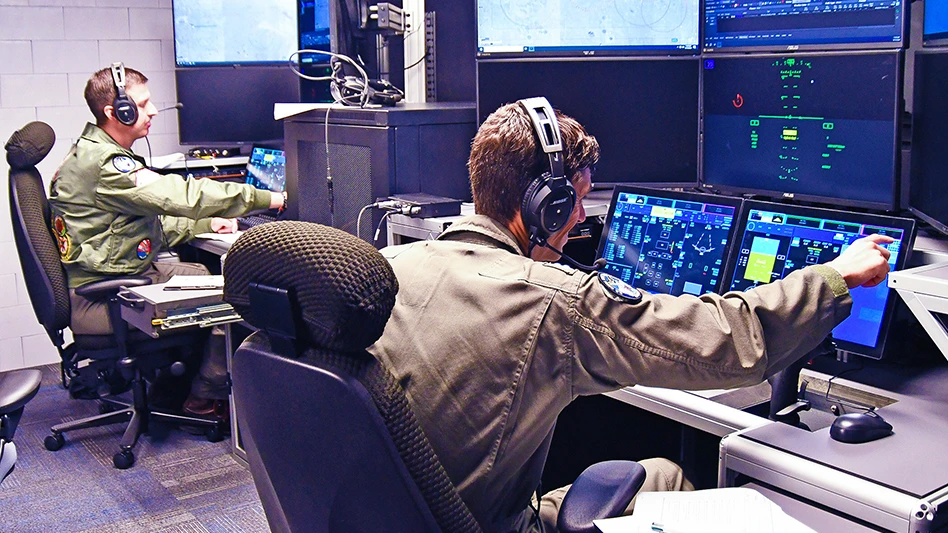
Photo courtesy of U.S. Navy
Lockheed Martin collaborated with the U.S. Navy and General Atomics (GA) in a first-ever live control flight demonstration of an uncrewed system by the Unmanned Carrier Aviation Mission Control Station (UMCS).
Powered by the Skunk Works MDCX autonomy platform, the UMCS controlled a GA MQ-20 Avenger uncrewed air system (UAS) as it completed a live fly mission. This demonstration is a pathfinder that helps to advance the complex technology necessary to enable crewed and uncrewed teaming as envisioned for programs such as CCA and others.
The flight test is a significant milestone in the development of UMCS, setting the stage for the Navy's future unmanned aviation operations.
MDCX enabled the U.S. Navy Air Vehicle Pilots at Patuxent River, Maryland to control the MQ-20 during its flight in California.
"Skunk Works is proud to collaborate with the Navy to bring its Carrier Air Wing of the Future vision to life," says John Clark, vice president and general manager, Lockheed Martin Skunk Works. "The MDCX made it possible to rapidly integrate the MQ-20 'autonomy core' with the UMCS, demonstrating common control capability and third-party platform integration."
"Autonomous collaborative platforms that are mission capable with technologies that have been demonstrated at high readiness levels and the maturation of those technologies is just one of the focus areas for GA-ASI," says GA-ASI President David R. Alexander. "This collaboration with the USN and Lockheed Martin advances the UMCS's beyond line-of-sight capabilities, while demonstrating the maturity of our Tactical Autonomy Core Ecosystem (TacACE)."
"This was a huge step for unmanned naval aviation," says Lt. Steven Wilster, MQ-25 AVP. "This demo showcased UMCS's first live control of an unmanned air vehicle, and it was great to be part of history in the making. The team is paving the way for integrating critical unmanned capability across the joint force to combat the high-end threat our warfighters face today and in the future."
The U.S. Navy, Air Force, and Marine Corps are collaborating via a Tri-Service Memorandum of Understanding on critical sub-systems for CCA platforms. The Navy leads the U.S. Department of Defense in developing a common control architecture and ground control station (GCS) for these systems. This work is being done in collaboration with Lockheed Martin Skunk Works, leveraging decades of operational experience delivering GCSs underpinned by the U.S. government's Open Mission Systems architecture for third-party platform integration for optimal interoperability.
The Navy will refine UMCS's requirements based on data from this demonstration and conduct further flight tests to advance command and control technologies, autonomy and crewed-uncrewed teaming.
Latest from Defense and Munitions
- SMW Autoblok Corporation appoints Brandon Mathis as National Sales Manager
- Bodycote expands U.S. aerospace and defense footprint with acquisition of Spectrum Thermal Processing
- AM Solutions’ automated surface finishing of 3D-printed parts
- Joint Interagency Task Force 401 expands counter-drone training
- Davie Defense awarded U.S. Coast Guard contract to build five Arctic Security Cutters
- Dillon Manufacturing’s Jaw Force Gauges
- Georgia Southern University partners with METAL to advance workforce training in metalworking and manufacturing
- AM General sells first HUMVEE Hawkeye 105mm mobile howitzer systems as part of three-year contract