Shield AI
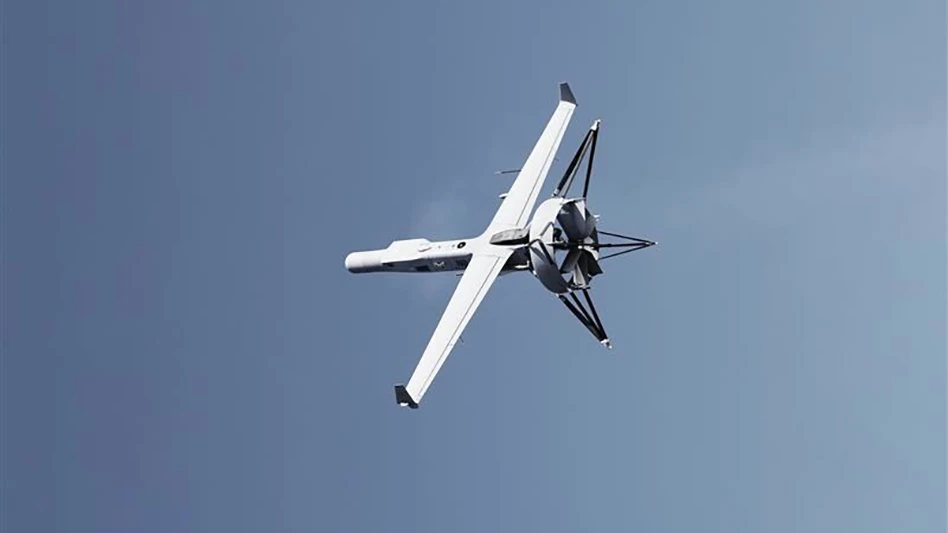
Shield AI's V-BAT successfully participated in Project Convergence Capstone 5 (PC-C5), a Combined, Joint, and multinational experiment held at Fort Irwin, California, in March 2025. V-BAT operated as part of the 82nd Airborne Division's missions in "The Box," Fort Irwin's famously demanding training area in the Mojave Desert.
V-BAT excelled against active jammers, successfully defeating electronic warfare threats and reinforcing its role as a force multiplier for Army units. Its performance demonstrated the ability to operate in contested conditions and provide critical Intelligence, Surveillance, Reconnaissance, and Targeting (ISR-T) support where traditional systems might be degraded or denied.
“V-BAT is designed to operate at every echelon within an Army division, executing the full spectrum of UAS missions,” says Brandon Tseng, Shield AI's President, Co-founder, and former Navy SEAL. “Whether supporting small units at the tactical edge or providing division-wide ISR-T, V-BAT delivers a critical advantage in contested and complex environments.”
During PC-C5, the 82nd Airborne Division experimented with employing V-BAT in long-range air assaults — testing ways to use today's technology on tomorrow's battlefield. Providing ISR-T at the tactical edge is a critical requirement for the Army, but legacy unmanned aircraft can't fit inside a UH-60 and would take up valuable space in a CH-47. V-BAT's unique size, endurance, and operational flexibility make it a highly capable solution for this mission set.
The V-BAT is the only single-engine ducted fan vertical takeoff and landing (VTOL) unmanned aircraft system (UAS) operationally deployed in multiple regions globally. With its unique ducted-fan design and the ability to launch and recover in confined spaces, it is ideally suited for shipborne and austere environments, ensuring flexibility and resilience in complex missions. V-BAT has earned its reputation for reliability, operating with impunity in GPS- and comms-denied environments. Its proven performance in contested regions like Ukraine, the Black Sea, and the Indo-Pacific demonstrates its ability to withstand advanced electronic warfare threats that have grounded many traditional drones.
The PC-C5 experiment brought together commanders and Soldiers to test and refine future warfighting concepts. V-BAT's performance showcased its multi-echelon adaptability, proving its effectiveness across all levels of Army division operations—from reconnaissance and surveillance to target acquisition and logistics support.
Latest from Defense and Munitions
- SMW Autoblok Corporation appoints Brandon Mathis as National Sales Manager
- Bodycote expands U.S. aerospace and defense footprint with acquisition of Spectrum Thermal Processing
- AM Solutions’ automated surface finishing of 3D-printed parts
- Joint Interagency Task Force 401 expands counter-drone training
- Davie Defense awarded U.S. Coast Guard contract to build five Arctic Security Cutters
- Dillon Manufacturing’s Jaw Force Gauges
- Georgia Southern University partners with METAL to advance workforce training in metalworking and manufacturing
- AM General sells first HUMVEE Hawkeye 105mm mobile howitzer systems as part of three-year contract