Scientific Systems Company, Inc.
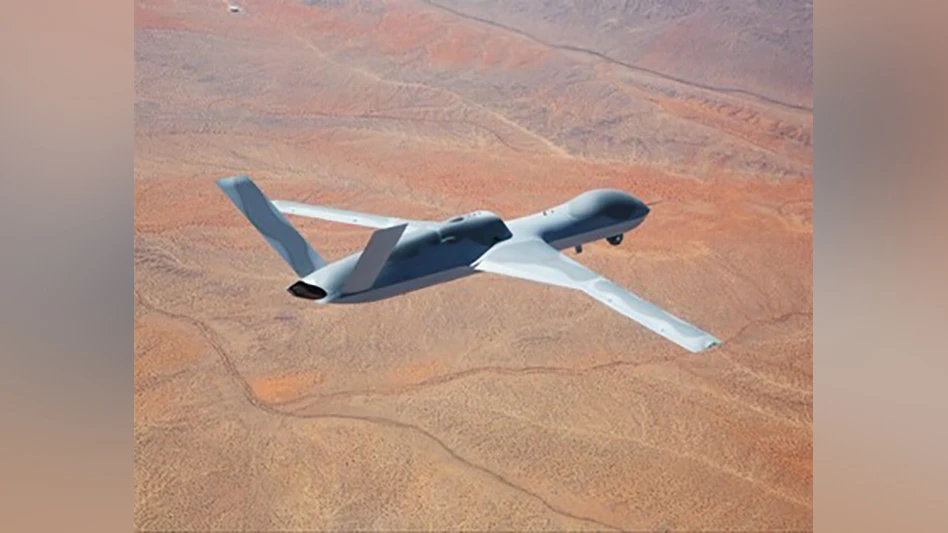
Scientific Systems Company, Inc. successfully demonstrated its Collaborative Sanitization Behavior aboard a General Atomics Aeronautical Systems, Inc. (GA-ASI) -owned MQ-20 Avenger Unmanned Aircraft System. This autonomous behavior, developed by Scientific Systems, empowers teams of UAVs to coordinate, share information, and execute autonomously to ensure sensor coverage over a critically defined area of interest and ultimately uninterrupted custody of a high-value target in real-time.
Using edge teaming behaviors at the core of this component-level capability, the software autonomously re-tasks each UAV within the team to meet mission priorities. These complex algorithms enable the team to collectively prosecute established contacts to ensure tactical execution without a human-in-the-loop requirement. Warfighter decision-making is therefore achieved at an accelerated pace in an environment where milliseconds matter.
"We’re thrilled to partner and work alongside GA-ASI on a world-class platform like the MQ-20 Avenger," says David "Heat" Lyons, Scientific Systems VP of Business Development and former F-16 Weapons Officer and combat fighter pilot. "Today's dynamic battlespace is more complex than ever. Enabling the warfighter with teaming collaborative mission autonomy that is not only capable and recognizable but also able to handle contingencies at the edge and in real-time is absolutely critical to mission success. That is what Scientific Systems is delivering to the warfighter and we look forward to future Air-Air mission demonstrations with General Atomics."
In support of this demonstration, Scientific Systems behaviors were integrated into and orchestrated by government-furnished equipment (GFE) autonomy core architecture enhanced by GA-ASI.
In addition to Collaborative Sanitization Behavior, Scientific Systems provides a wide array of behaviors in its Collaborative Mission Autonomy suite of products. The software adapts to mission contingencies such as mission system failures, connectivity dropout, and combat losses due to adversary action to ensure tactical execution. This same software was previously demonstrated at scales of up to 30 teaming UAVs, in experiments with 5 live and 25 virtual platforms, across a diverse set of DARPA and other OSD programs.
Latest from Defense and Munitions
- SMW Autoblok Corporation appoints Brandon Mathis as National Sales Manager
- Bodycote expands U.S. aerospace and defense footprint with acquisition of Spectrum Thermal Processing
- AM Solutions’ automated surface finishing of 3D-printed parts
- Joint Interagency Task Force 401 expands counter-drone training
- Davie Defense awarded U.S. Coast Guard contract to build five Arctic Security Cutters
- Dillon Manufacturing’s Jaw Force Gauges
- Georgia Southern University partners with METAL to advance workforce training in metalworking and manufacturing
- AM General sells first HUMVEE Hawkeye 105mm mobile howitzer systems as part of three-year contract