Scientific Systems Company, Inc. (SSCI)
Scientific Systems Company, Inc. (SSCI) successfully flew multiple flight tests of its Collaborative Mission Autonomy (CMA) software running on a live General Atomics Aeronautical Systems, Inc. (GA-ASI) MQ-20 Avenger Unmanned Combat Air Vehicle. In these November 2023 flight tests, CMA software commanded a mixed team of Live, Virtual, and Constructive (LVC) MQ-20 platforms to execute a fully autonomous multi-vehicle Defensive Counter Air mission.
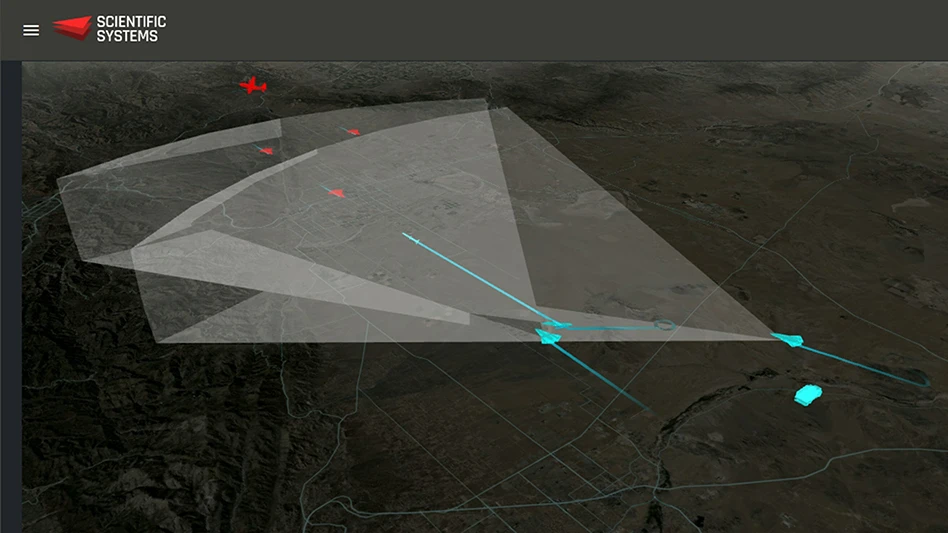
The tests used a mix of LVC platforms, sensors, and effectors to encompass all aspects of a realistic, operationally relevant F2T2EA (Find, Fix, Track, Target, Engage, Assess) air combat mission, including combat air patrol, detection, identification, tracking, targeting, and engagement of multiple targets throughout multiple scenarios. Scientific Systems' software was embedded onboard all the live, virtual, and constructive MQ-20 platforms, successfully managing the autonomous mission at the edge to compensate for communication and coordination challenges. Virtual and constructive elements of the scenario were modeled in the U.S. Air Force's AFSIM (Advanced Framework for Simulation, Integration, and Modeling software environment). In support of these November flight tests, collaborative autonomy behaviors from Scientific Systems and other organizations were integrated into and orchestrated using a GFE (government-furnished equipment) autonomy software architecture enhanced by GA-ASI.
Scientific Systems' Collaborative Mission Autonomy (CMA) software consists of AI (Artificial Intelligence) and ML (Machine Learning)-driven software for coordinating multi-vehicle decentralized mission execution. Scientific Systems' algorithms use operator pre-mission inputs to generate tailored, coordinated flight behaviors that address mission objectives by optimizing aircraft positioning, engagement parameters, and defensive maneuvers. In-flight optimization algorithms running at the edge allow the CMA-driven uncrewed team to autonomously replan and re-coordinate their tasking and positioning, even when disconnected from their human operators to account for dynamically changing mission constraints. In previous demonstrations, CMA handled a variety of unpredictable in-flight circumstances and contingencies such as communication outages, lost teammates, and enemy threat positioning.
"Together with GA-ASI, we're focused on the rapid development, integration, testing, and demonstration of our collaborative autonomy behaviors," says David "Heat" Lyons, Scientific Systems' VP of Business Development and former F-16 Weapons Officer and combat fighter pilot. "Moreover, we're convincingly demonstrating that our open architecture software works not just in a simulation environment but works to command a live and operationally relevant Group 5 platform like the MQ-20 Avenger, in combat representative operating conditions."
The November flight tests are just the latest instance of Scientific Systems successfully integrating and demonstrating its collaborative mission autonomy software on third-party platforms in operational contexts of relevance to the U.S. Department of Defense. Earlier Scientific Systems test flight programs have successfully demonstrated a variety of air-to-ground, and ground support missions.
Latest from Defense and Munitions
- SMW Autoblok Corporation appoints Brandon Mathis as National Sales Manager
- Bodycote expands U.S. aerospace and defense footprint with acquisition of Spectrum Thermal Processing
- AM Solutions’ automated surface finishing of 3D-printed parts
- Joint Interagency Task Force 401 expands counter-drone training
- Davie Defense awarded U.S. Coast Guard contract to build five Arctic Security Cutters
- Dillon Manufacturing’s Jaw Force Gauges
- Georgia Southern University partners with METAL to advance workforce training in metalworking and manufacturing
- AM General sells first HUMVEE Hawkeye 105mm mobile howitzer systems as part of three-year contract