SAKOR Technologies Inc.
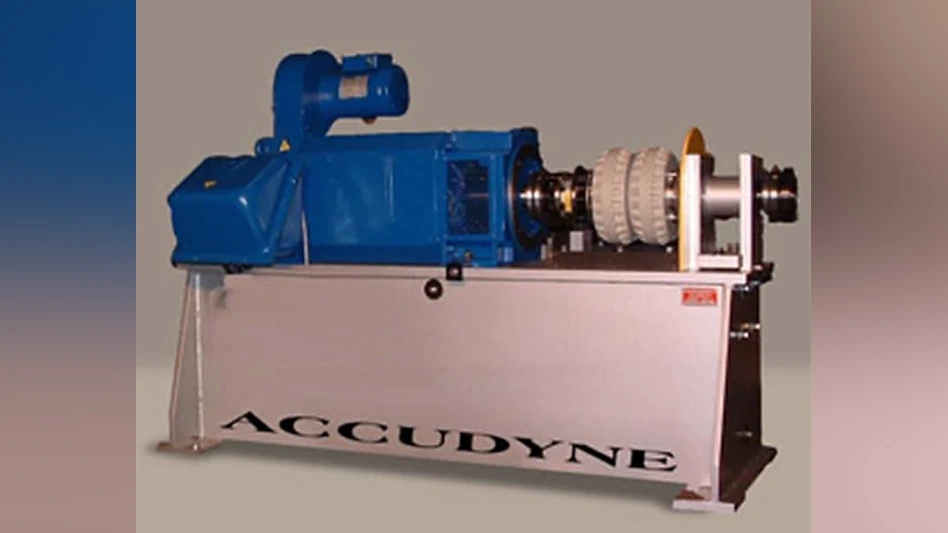
SAKOR Technologies Inc., a recognized leader in high-performance dynamometer systems, announces it has supplied a major aerospace and defense company with a test system for performing automated testing of very low speed/high torque motors used in swing wing reusable spacecraft applications. The test system uses SAKOR’s AccuDyne AC motoring dynamometer configured to provide the required torques and speeds. SAKOR’s new DynoLAB GenV next generation data acquisition and control system automates the entire test stand, acting as a spacecraft emulator.
The four-quadrant AccuDyne dynamometer is capable of full bi-directional loading and motoring of the unit under test. It can also provide full rated torque over its entire operating range, including stall (zero rpm). Featuring continuous motoring and absorbing, regenerative braking, and extremely low but precisely controlled minimum speed (0.017rpm), it provides up to 110,000 Newton-meters (Nm) torque over its entire operating range.
SAKOR’s next generation DynoLAB GenV test automation controller makes it even easier to implement complex test systems and subsystems, and delivers a new benchmark in modularity, performance, robustness, and expandability. The powerful new DynoLAB GenV graphical test sequence editor allows users to easily define arbitrarily complex automated test sequences. This allows the DynoLAB GenV system to automate anything from simple test benches to entire test cells and autonomous complex subsystems.
“We're extremely happy to have been selected to work with this company again on their cutting-edge technology, which is so critical to our nation’s next-generation space capabilities,” says Randal Beattie, president of SAKOR. “We're confident that the system will push the design envelope to ensure that atmospheric control systems can handle anything they may have thrown at them.”
Latest from Defense and Munitions
- SMW Autoblok Corporation appoints Brandon Mathis as National Sales Manager
- Bodycote expands U.S. aerospace and defense footprint with acquisition of Spectrum Thermal Processing
- AM Solutions’ automated surface finishing of 3D-printed parts
- Joint Interagency Task Force 401 expands counter-drone training
- Davie Defense awarded U.S. Coast Guard contract to build five Arctic Security Cutters
- Dillon Manufacturing’s Jaw Force Gauges
- Georgia Southern University partners with METAL to advance workforce training in metalworking and manufacturing
- AM General sells first HUMVEE Hawkeye 105mm mobile howitzer systems as part of three-year contract