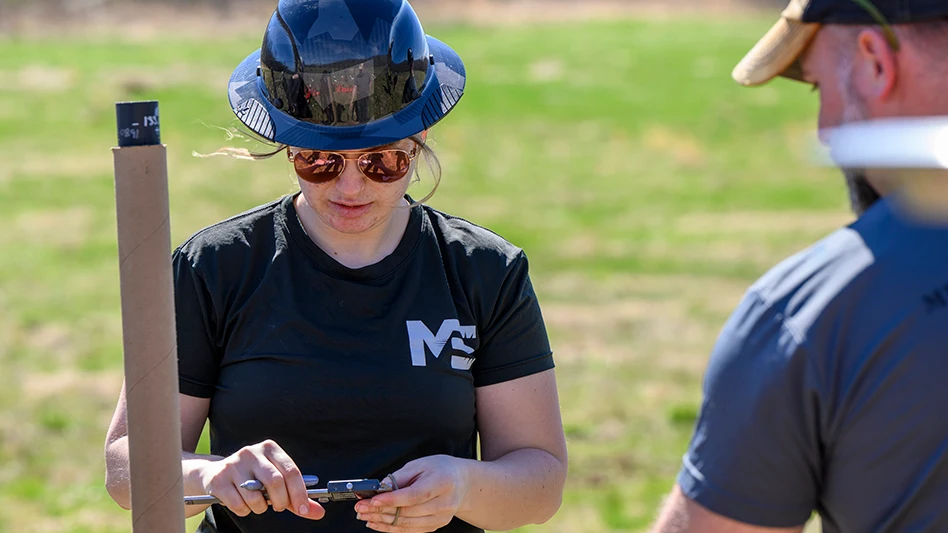
Photo by Michael Pierce/Missouri S&T
Bullets move fast. Prototyping them? Not so much. But a Ph.D. student in mechanical engineering at Missouri University of Science and Technology is researching an accelerated process for producing and testing 3D-printed ballistics, and she has already earned international recognition.
“What’s exciting about my research is that it shows 3D-printed ammunition prototypes can potentially go straight from the printer to test-firing — cutting several hours from post-processing,” says Avery Lyons, a Kummer Innovation and Entrepreneurship Doctoral Fellow from Bay St. Louis, Mississippi.
According to Lyons, the sintering step, which normally removes the plastic binder from the printed part and fuses the metal particles together, can take more than a day.
“But my research shows that step may not be necessary for early testing of rounds, and we can still get reliable data to see how different designs perform,” she says. “Of course, any round needs extensive testing before it can be mass produced, but the early characterization of accuracy and flight stability is where this research really takes the stage.”
One of Lyons’ accolades for her research testing 3D-printed copper rounds without the standard post-processing includes earning second place in the International Ballistics Symposium in Jacksonville, Florida, this summer with 140 entries from industry professionals, scholars and students.
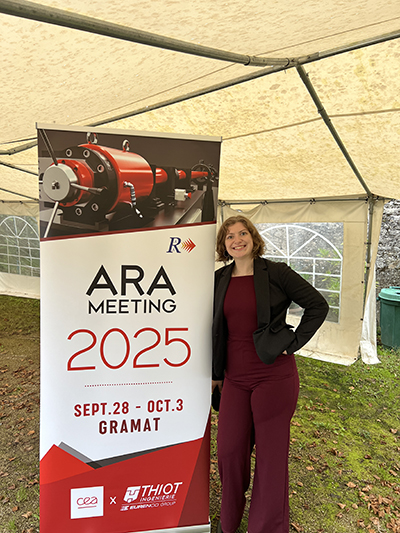
This fall, she was then one of five students awarded funding through the Student Participation Program at the 74th annual meeting of the Aeroballistic Range Association in Gramat, France, which provided her with travel support and a platform to share her work with top aeroballistics researchers and professionals.
During this trip, she also participated in the Military Aspects of Blast and Shock 27th Symposium in Colmar, France, and spent time in Germany discussing potential international collaborations and checking out other projects related to her field.
But even though her research is now recognized across Europe and beyond, her roots are in the Deep South.
Planned to be a pilot
Growing up in Bay St. Louis, Mississippi, Lyons says she was drawn to science and service from an early age.
In high school, she led a 125-member unit of Air Force JROTC, was on her school’s powerlifting team and worked two part-time jobs.
A senior, she was accepted into several universities and decided to attend S&T.
“I originally wanted to attend the Naval Academy and become a Marine Corps helicopter pilot,” she says. “However, life had other plans, and those plans took me to Rolla, Missouri.”
Passion for people vs. particles
When Lyons came to S&T in 2019, she intended to earn a degree in physics.
But after taking more courses in that discipline, she realized she needed a better outlet for her desire to lead and work with people, which led her to study engineering management.
“Physics is fascinating, but I learned that I am much more passionate about people than particles,” she says.
“Engineering management was a better personality fit for me, and it allowed me to use my natural leadership abilities and still learn about STEM.”
Meeting her mentor
As an engineering management major, she first connected with Dr. Phillip Mulligan, an assistant professor of mechanical and aerospace engineering and an expert in explosives engineering, in his first-year design class.
Later in the semester, she took on a work-study position with Mulligan.
“Avery started out organizing the engineering design shop and sweeping the floors, but by the following semester, she was a shop supervisor,” Mulligan says. “Then, the next semester, she started in a new position as the shop foreman and oversaw all of the supervisors.”
After that, her work with Mulligan as an undergraduate student expanded to her helping manage his increasing number of research projects.
As Lyons’ May 2024 graduation for her bachelor’s degree grew closer, she says Mulligan encouraged her to apply for a Kummer I&E Doctoral Fellowship at Missouri S&T.
This fellowship now covers her tuition and provides her with additional funding and professional development opportunities.
“Avery is the embodiment of the intersection between curiosity, tenacity and intelligence,” Mulligan says. “I’ve never seen her back down from a problem. She’s learning when to ask for help, and she continually pushes forward to reach her goals.”
From side project to standout research
Even though she is now winning awards for her ballistics research, Lyons says this rapid prototyping project for ammunition is not the primary focus of her Ph.D.
“The crazy thing is this 3D-printing work started as a side project,” Lyons says. “It was just something I was curious about testing, but it worked so much better than I could have imagined.
“Even a few years ago, I never would have guessed I’d be a Kummer I&E Fellow at Missouri S&T, firing 3D-printed slugs into a foam backstop. But I want my work to support the people who keep our communities and nation safe, and if faster prototyping leads to better designs and more reliable materials, that’s a win for everyone.”
What’s next
Lyons’ main research area for her Ph.D. is creating new organic explosive materials using ultraviolet light, but she says she will continue her ballistics research as well.
Earlier this year, she co-founded a startup company called PulsePoint Technologies with Bo Mahaney, a retired U.S. Air Force major general and director of S&T’s Policy and Armed Forces Research and Development Institute, and Janae Dill, a first-year student in electrical engineering. The company is currently developing technology for the power and energy sector.
She also recently shared her insights on a student entrepreneur panel at S&T as part of the university’s Kummer Day festivities.
As Lyons works toward competing a Ph.D. in mechanical engineering, she will earn a master’s degree in explosives engineering as well.
After she earns those degrees and becomes a three-time Missouri S&T alumna, Lyons says her goal is to either work for the U.S. government or in the private sector.
“This path wasn’t what I expected, but Missouri S&T and Dr. Mulligan have opened doors I didn’t even know were there,” she says. “It has been such a good fit for me, and in more ways than one, it has really been a blast.”
Latest from Defense and Munitions
- L3Harris receives new contract to power THAAD Interceptors
- DMG MORI's DMF 600|11 moving column machines
- Auterion, Airlogix launch German-Ukrainian joint venture to scale autonomous drone production for Ukraine and NATO Allies
- Wingcopter, TAF Industries establish Joint Venture to scale production of reconnaissance drones in Germany for Ukraine
- Abaco Systems' FMC600 fiber optic module carrier
- CERATIZIT shares insight into defense manufacturing
- Allen Control Systems wins U.S. Army’s xTechOverwatch competition for breakthrough in autonomous counter-drone systems
- MKS' Ophir BeamWatch AM-3 additive manufacturing beam analyzer