Teledyne FLIR Defense
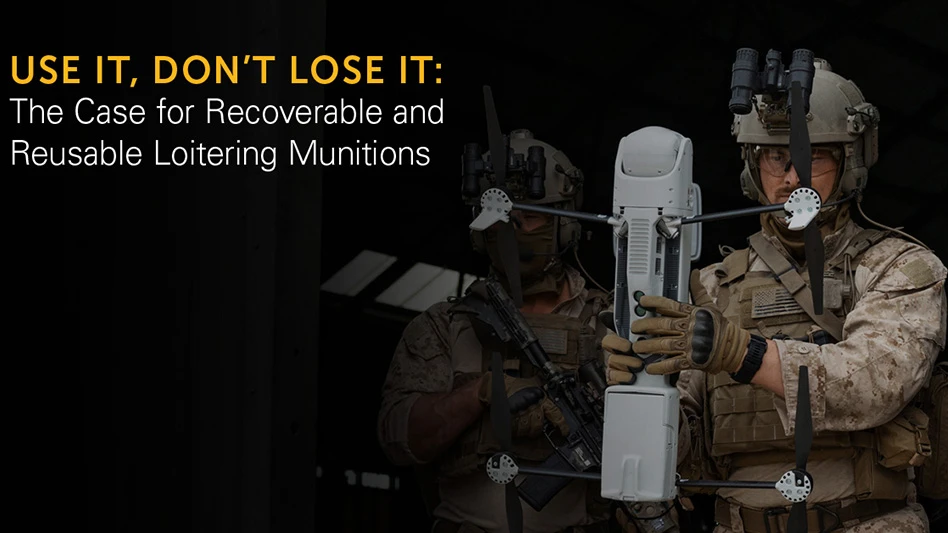
In a new whitepaper, Teledyne FLIR Defense, part of Teledyne Technologies Incorporated, says emerging cost-effective precision strike solutions that can be safely recovered and reused offer a strong alternative to more commonly deployed ‘One-Way Attack’ or First Person View (FPV) drones.
In the new paper, USE IT, DON’T LOSE IT: The Case for Recoverable and Reusable Loitering Munitions, FLIR Defense argues that newer, advanced loitering munition unmanned aircraft systems (LMUAS) are better suited to support operations in the ‘atmospheric littoral.’ An emerging strategic concept, the atmospheric littoral describes the very low-altitude airspace (up to several hundred feet above ground level) which, if controlled, can significantly enhance the ground maneuver of combat units.
The paper highlights the total ownership cost of FPV and legacy loitering munitions currently on the market. Most systems are single use, so whether they successfully hit a target or not, they are a spent cost. These types of munitions are more expensive and complicated to train with, operate, and maintain, compared to recoverable LMUAS that can be safely brought back if target conditions change, or fitted with an inert payload for training exercises.
The whitepaper also explains how newer recoverable LMUAS, such as the FLIR Defense Rogue 1™, can deliver greater precision strike capability to warfighters at the tactical edge. Rogue 1’s patented gimballed warhead allows users to ‘point’ and deliver its munitions far more accurately, so that the lightweight system can disable armored platforms by targeting vulnerable spots on the vehicle. Increased precision makes up for the reduced payload capacity of the VTOL airframe compared to larger, fixed-wing platforms that can deliver heavier payloads but with less accuracy.
“Recoverable LMUAS offer small fighting units a big advantage when they can train more efficiently, deliver precision effects on the battlefield, and yet be able to reuse a system when target conditions change up to the last second,” says Dave Viens, vice president of US Business Development at Teledyne FLIR Defense. “As our ‘Use it, Don’t Lose It’ whitepaper points out, the atmospheric littoral has quickly become the key battlespace warfighters must control – and dominate – to defeat our enemies in modern conflicts.
“We believe the critical technologies embodied in the Rogue 1 lethal UAS offer distinct advantages to traditional ‘one-way’ FPV drones, giving combat units the edge they need to control the atmospheric littoral,” Viens adds.
Other key points in the paper include:
- ‘One-Way Attack’ and ‘First Person View’ drones often suffer from major operational disadvantages across the battlespace, particularly in terms of cost, training, use case DEV/OPS, lethal effect, and precision.
- Recoverable and reusable loitering munitions not only reduce capital expenditure and training cycles but also optimize mission success.
- Military-grade quadrotor loitering munitions equipped with state-of-the-art fuzing solutions and precision payloads are ideally suited to satisfy emerging demand signals at the tactical edge.
- Next-generation technologies, including ML/AI tools such as Aided Target Recognition (AiTR), will open more possibilities for loitering munitions in the near future.
Click here to download the new Teledyne FLIR Defense whitepaper, USE IT, DON’T LOSE IT: The Case for Recoverable and Reusable Loitering Munitions.
Latest from Defense and Munitions
- SMW Autoblok Corporation appoints Brandon Mathis as National Sales Manager
- Bodycote expands U.S. aerospace and defense footprint with acquisition of Spectrum Thermal Processing
- AM Solutions’ automated surface finishing of 3D-printed parts
- Joint Interagency Task Force 401 expands counter-drone training
- Davie Defense awarded U.S. Coast Guard contract to build five Arctic Security Cutters
- Dillon Manufacturing’s Jaw Force Gauges
- Georgia Southern University partners with METAL to advance workforce training in metalworking and manufacturing
- AM General sells first HUMVEE Hawkeye 105mm mobile howitzer systems as part of three-year contract