U.S. Missile Defense Agency
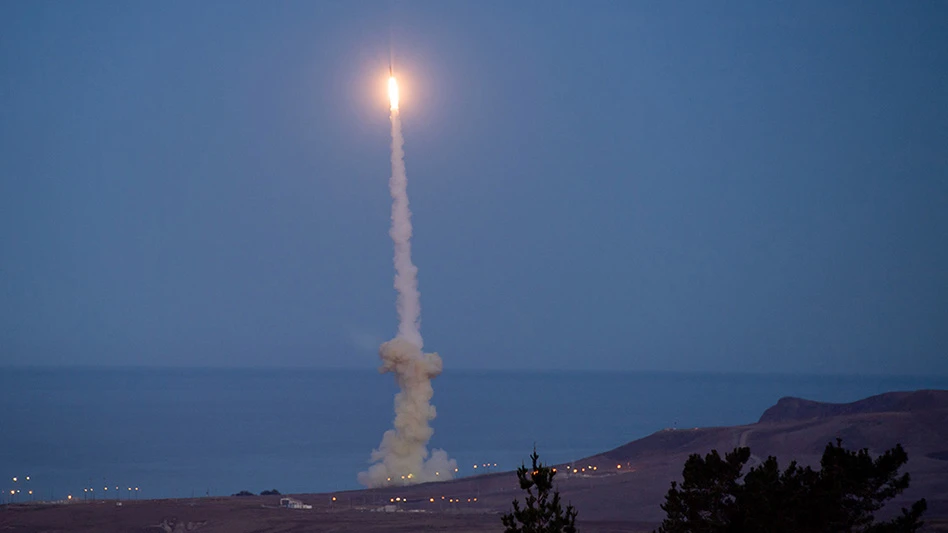
The U.S. Missile Defense Agency and a Boeing-led industry team successfully intercepted an intermediate-range ballistic missile in space during the latest test of the Ground-based Midcourse Defense, or GMD, system. The test validated GMD's Capability Increment 6B configuration, which gives the Missile Defense Operators more time, space, and flexibility to intercept ballistic missile threats to the U.S. homeland.
During the test, a GMD interceptor released a kinetic-force Exoatmospheric Kill Vehicle, or EKV, during the rocket booster's second stage of its normally three-stage sequence of flight. The threat-representative target was air launched from the Broad Ocean Area and the interceptor was deployed from Vandenberg Space Force Base, California.
"This successful test is important because it opens up the window of opportunity to intercept threats to our homeland," says Debbie Barnett, vice president of Strategic Missile & Defense Systems at Boeing. "We're committed to continuously enhancing the GMD system's capability to meet rapidly evolving missile defense needs for the nation."
Boeing has supported the GMD program as lead system integrator since its inception in 1998 through development, test operations, and sustainment. The system has now been on alert for nearly two decades and is an integral part of America's layered ballistic missile defense architecture.
Latest from Defense and Munitions
- SMW Autoblok Corporation appoints Brandon Mathis as National Sales Manager
- Bodycote expands U.S. aerospace and defense footprint with acquisition of Spectrum Thermal Processing
- AM Solutions’ automated surface finishing of 3D-printed parts
- Joint Interagency Task Force 401 expands counter-drone training
- Davie Defense awarded U.S. Coast Guard contract to build five Arctic Security Cutters
- Dillon Manufacturing’s Jaw Force Gauges
- Georgia Southern University partners with METAL to advance workforce training in metalworking and manufacturing
- AM General sells first HUMVEE Hawkeye 105mm mobile howitzer systems as part of three-year contract