Marotta Controls
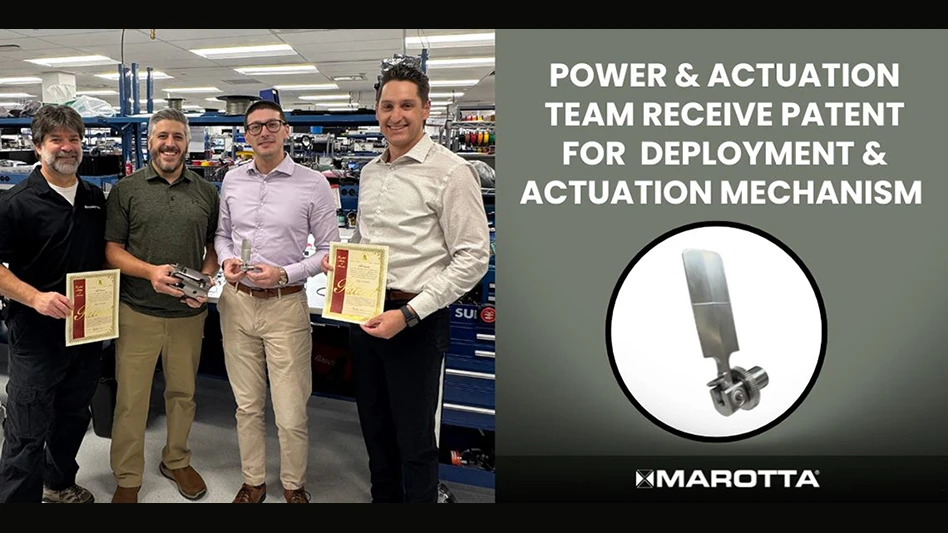
Marotta Controls, a longstanding and leading innovator in aerospace and defense, has been awarded U.S. Patent No. 12,287,181 for its groundbreaking control surface deployment and actuation mechanism. This novel design combines the deployment and movement of control surfaces — such as fins used on missiles, guided munitions, and other maneuverable vehicles — into a single, compact unit. By integrating these functions into one device, the design saves space, simplifies integration, and improves overall reliability. The technology was developed by Marotta engineers: Vito Guardi, Travis Spaulding, John Albright, and Brett Seidman.
Deployment and actuation have traditionally required separate mechanisms, each occupying valuable system space and increasing potential points of failure. Marotta’s patented solution uses a single drive train to release and control the fins, eliminating the need for additional motors or release devices. This streamlined approach is particularly beneficial in space-constrained applications, such as gun-launched munitions, where every cubic inch counts.
“This invention was born from a customer challenge where the available space simply couldn’t accommodate multiple mechanisms,” says Vito Guardi, Senior Manager, Mechanical Engineering at Marotta Controls. “By rethinking how we deploy and drive fins, we developed a solution that not only fits the tight envelope but also enhances reliability and testability for high-performance systems.”
The mechanism also uniquely offers a resettable design, allowing full functional testing at the customer’s facility without sacrificing the hardware. Unlike one-time-use devices, which must be replaced after testing, Marotta’s system can be reloaded and retested, providing customers with confidence in its performance before deployment in the field.
While the patent was developed for a gun-launched guided round, its benefits extend to a wide range of platforms, including torpedoes, UAVs, and other systems where stowed control surfaces are advantageous for storage, transport, or aerodynamic performance.
“This patent reinforces Marotta’s reputation for solving the kinds of engineering challenges others shy away from,” says Guardi. “It also demonstrates our ability to innovate within severe constraints of space and performance, delivering solutions that keep our customers competitive in the most demanding environments.”
The patented technology has been successfully tested in high-G environments and has already demonstrated its value in meeting strict performance and integration requirements. It marks one of two U.S. patents awarded to Marotta in 2025; the other is for a new synchronous rectification technique used in high-current power conversion.
Latest from Defense and Munitions
- SMW Autoblok Corporation appoints Brandon Mathis as National Sales Manager
- Bodycote expands U.S. aerospace and defense footprint with acquisition of Spectrum Thermal Processing
- AM Solutions’ automated surface finishing of 3D-printed parts
- Joint Interagency Task Force 401 expands counter-drone training
- Davie Defense awarded U.S. Coast Guard contract to build five Arctic Security Cutters
- Dillon Manufacturing’s Jaw Force Gauges
- Georgia Southern University partners with METAL to advance workforce training in metalworking and manufacturing
- AM General sells first HUMVEE Hawkeye 105mm mobile howitzer systems as part of three-year contract