Hanwha Systems
Hanwha Systems has signed a contract with South Korea’s Agency for Defense Development (ADD) to develop a next-generation Multi-Function Radar (MFR) for the L-SAM-II, the second phase of the Long-Range Surface-to-Air Missile) system. The contract is valued at approximately $40 million (KRW 54.7 billion).
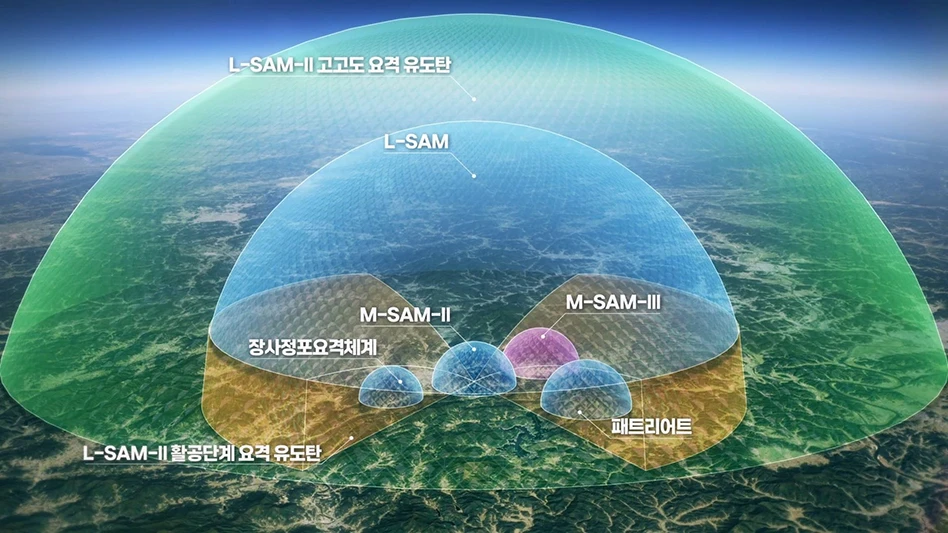
Nicknamed the ‘K-THAAD’, the L-SAM-II system will be capable of intercepting ballistic missiles at higher altitudes and longer ranges than the original L-SAM, which completed development at the end of 2024. This new system adds a critical layer to South Korea’s multi-tiered missile defense network against growing regional threats.
Compared to its predecessor, the L-SAM-II offers three to four times greater coverage and features advanced radar technology, improved command-and-control systems, and upgraded interceptor missiles. These enhancements will enable more accurate and timely responses to high-altitude missile threats.
The Multi-Function Radar, often referred to as the "eyes" of a surface-to-air missile system, plays a critical role in the L-SAM-II. It can detect and track multiple long-range targets in real-time, while also performing key functions such as friend-or-foe identification of aircraft and missile guidance—making it essential for engaging ballistic missile threats. This is why the radar is considered one of the core technologies of the L-SAM-II system.
Notably, the new radar for L-SAM-II applies advanced high-precision algorithms optimized for upper-tier interception. Compared to the MFRs used in M-SAM II and the first-generation L-SAM, it offers significantly extended detection and tracking ranges for ballistic missile targets. As a result, it can more reliably support the interception of high-speed, high-altitude threats such as long-range ballistic missiles and hostile aircraft. Additionally, the radar is capable of distinguishing between real threats, friendly forces, and non-threatening objects such as debris, further improving operational efficiency and battlefield decision-making.
“The radar is the core of any air defense system,” says Hyuk Park, Head of Hanwha Systems’ Defense Electronics Division. “We’re committed to delivering cutting-edge solutions tailored to meet the needs of today’s complex battlefield.”
With decades of experience in radar and defense electronics, Hanwha Systems has demonstrated proven capabilities across land, air, and naval platforms. Its portfolio includes AESA radars for the KF-21 next-generation fighter jet, multi-function radar systems for the Korean Destroyer (KDDX), and the FFX Batch-III frigate. Building on this foundation, Hanwha Systems also plans to enter the global Early Warning Radar (EWR) market. Its future EWR system, designed to detect missiles from over 2,000 to 3,000 km away, will be a vital part of any strategic air defense network.
Latest from Defense and Munitions
- SMW Autoblok Corporation appoints Brandon Mathis as National Sales Manager
- Bodycote expands U.S. aerospace and defense footprint with acquisition of Spectrum Thermal Processing
- AM Solutions’ automated surface finishing of 3D-printed parts
- Joint Interagency Task Force 401 expands counter-drone training
- Davie Defense awarded U.S. Coast Guard contract to build five Arctic Security Cutters
- Dillon Manufacturing’s Jaw Force Gauges
- Georgia Southern University partners with METAL to advance workforce training in metalworking and manufacturing
- AM General sells first HUMVEE Hawkeye 105mm mobile howitzer systems as part of three-year contract