Element U.S. Space & Defense
Element U.S. Space & Defense, a government testing partner and innovator in space exploration since the 1960s, is collaborating with Texas Tech University’s Mechanical Engineering Department to explore the intricate process of gun propellant ignition and its effects on interior ballistics. The work is positioned to significantly aid the Department of Defense (DOD) in predicting and modeling gun chamber combustion.
Led by Dr. Michelle Pantoya of the Texas Tech Combustion Lab, the study will focus on the complex dynamics of solid propellant ignition. Joining the project is Dr. John Granier, Chief Engineer of Munitions & Energetics at Element U.S. Space & Defense, along with his team of scientists and subject matter experts, with additional support from the U.S. Army Combat Capabilities Development Command – Armaments Center at Picatinny Arsenal.
This task force aims to break down complex problems and apply new diagnostic techniques to capture more detailed insights into the ignition process. The research seeks to advance our understanding of how the heat and chemicals from the primer interact with the solid propellant. These interactions, where hot gases and particles penetrate the propellant grains, are crucial for improving pressure, temperature and projectile velocity predictions.
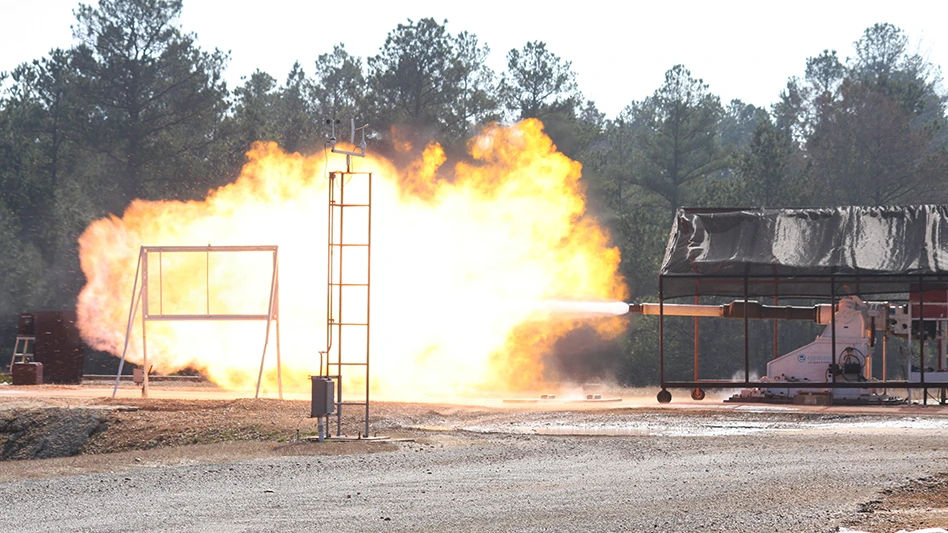
This initial study will primarily take place at the Texas Tech Combustion Lab using a new high-speed digital imaging thermography, with Element U.S. Space & Defense’s ballistics experts supporting in experiment design and data analysis. It is expected that this effort will grow to larger experiments of full-scale guns and artillery with Element U.S. Space & Defense’s Camden facility playing a significant role. Located in Arkansas, the Camden facility is a comprehensive ordnance and ballistic test center, renowned for its state-of-the-art lab and testing capabilities. The laboratory is equipped to conduct a myriad of tests on weapon systems, ordnance, rocket motors and hazardous materials, supporting a wide range of military systems, including live firings, environmental, dynamics and explosive testing.
“We're excited to embark on this groundbreaking study of early propellant ignition in collaboration with the Element U.S. Space & Defense team,” says Dr. Michelle Pantoya, JW Wright Regents Endowed Chair Professor of Mechanical Engineering at Texas Tech University. “The expertise of Element U.S. Space & Defense’s engineers and the extensive capabilities of their Camden facility will be crucial in enhancing our experimental design, analysis and overall results. We anticipate that this research will not only advance the DoD’s work but also provide valuable insights for weapon designers and develop new diagnostics applicable across various fields. Additionally, this project offers a significant opportunity for our graduate-level engineering students to gain hands-on experience and contribute to cutting-edge research.”
A better understanding of propellant ignition is expected to enhance the safety and reliability of firearms by reducing risks such as hang fires, pressure spikes or incomplete burns. Improved ignition control could also lead to lower costs for munitions production and maintenance by minimizing defects and boosting combustion efficiency. Overall, the findings from this study are anticipated to advance primer and propellant technologies, leading to more effective and efficient materials as well as more accurate models of gun systems which could be crucial for enhancing operational effectiveness in military applications.

“As an organization committed to innovation and national security, Element U.S. Space & Defense is thrilled to partner with Texas Tech University on this propellant ignition study,” adds Dr. John Granier, Chief Engineer of Munitions & Energetics at Element U.S. Space & Defense. “We’re applying Texas Tech’s thermography diagnostic equipment and our experience to achieve a deep understanding to a problem that is almost a century old. We look forward to uncovering breakthrough findings alongside Dr. Pantoya and her talented team at Texas Tech, which will be instrumental to the U.S. Defense sector.”
Latest from Defense and Munitions
- US Navy selects L3Harris Red Wolf for Precision Attack Strike Munition program
- Snowbird Technologies integrates Meltio Engine Blue into containerized hybrid manufacturing system for defense
- Precision Additive's PA-300 LPBF 3D metal printer
- BIG DAISHOWA supports future of manufacturing with Tools for Schools program
- Mission-Ready: Hutchinson Aerospace & Industry achieves CMMC Level 2 certification
- Shotling's anti-drone shotgun
- ACMI breaks ground on first national manufacturing campus in Indiana, pioneering new model for American defense production
- December 2025 U.S. cutting tool shipments totaled $215M