Babcock International Group, the defence company, and Plastometrex, are supporting Project TAMPA, the UK Ministry of Defence’s flagship initiative to accelerate the adoption of additive manufacturing (AM) in the defense supply chain.
The programmed addresses a critical challenge: how to ensure the Armed Forces can access vital components when global supply chains are stretched, traditional suppliers are unavailable, or parts have become obsolete. By proving that parts can be manufactured digitally, produced by multiple suppliers, and still meet stringent defense standards, Project TAMPA is laying the foundation for a more resilient, secure, and flexible supply chain.
Babcock, a current Plastometrex customer, will coordinate the manufacture of laser powder bed additive parts and oversee the comparison of components produced by different suppliers. Their task is to demonstrate that distributed manufacturing can deliver equivalent, certifiable outcomes to those already approved, ensuring the MOD can maintain operational readiness even when conventional routes are disrupted.
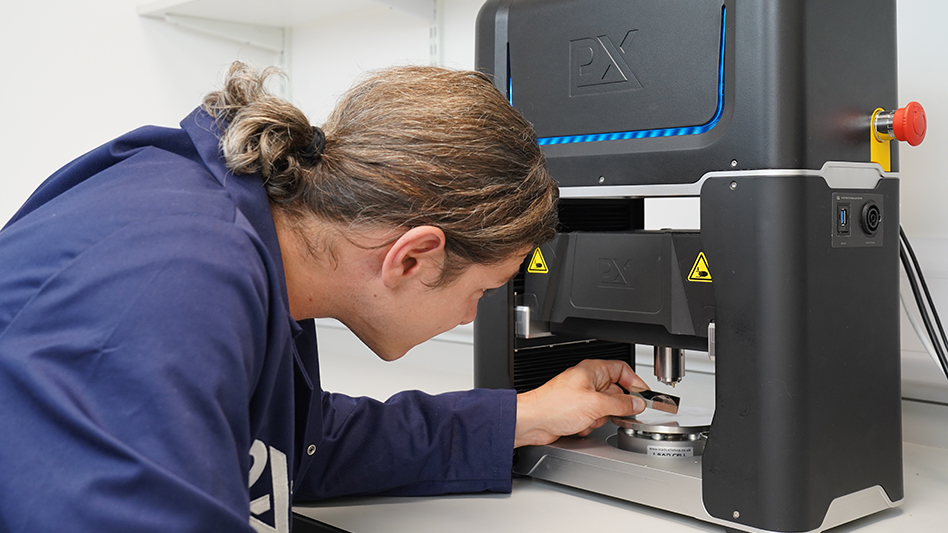
Plastometrex will contribute its Profilometry-based Indentation Plastometry (PIP) technology, delivered through the PLX-Benchtop system. PIP is a physics-based approach that extracts stress-strain curves from indentation test data using an inverse finite element method. It provides faster, lower-cost, and richer evaluations of mechanical properties than destructive tensile testing. Unlike tensile testing, it can also be performed directly on parts or samples as small as 1.5 x 1.5 x 0.75mm and at finer resolution. Areas that this capability will support the project with, include:
- Within-build variation: detecting property changes through the height of an AM build that tensile testing often misses.
- Build-to-build variation: identifying differences between builds more rapidly and affordably.
- Equivalency demonstrations: proving alignment with tensile results across a range of alloys produced via laser powder bed fusion.
By enabling rapid, non-destructive validation of part performance, PIP makes it possible to compare and qualify parts at the speed digital supply chains demand - an essential capability for ensuring availability in critical defense programs. Work on these elements is expected to begin in early November.
“Project TAMPA is about more than advancing additive manufacturing, it’s about national resilience,” says Dr Mike Coto, CCO at Plastometrex. “The ability to securely share digital designs, manufacture parts where they are needed, and know with confidence that those parts will perform as expected is transformative for defense. PIP enables that confidence, reducing reliance on slow and destructive methods, and ensuring that the MOD can access the parts it needs, when it needs them.”
“We'll develop solutions for complex parts across various platforms to ensure material availability, reduce obsolescence, and enhance the MOD’s defense capabilities,” says Kate Robinson, Managing Director Through Life Equipment Support (TLES), Babcock. “Our collaboration with Plastometrex is a terrific example of how innovation can accelerate the adoption of additive manufacturing within the defense supply chain.”
Latest from Defense and Munitions
- US Navy selects L3Harris Red Wolf for Precision Attack Strike Munition program
- Snowbird Technologies integrates Meltio Engine Blue into containerized hybrid manufacturing system for defense
- Precision Additive's PA-300 LPBF 3D metal printer
- BIG DAISHOWA supports future of manufacturing with Tools for Schools program
- Mission-Ready: Hutchinson Aerospace & Industry achieves CMMC Level 2 certification
- Shotling's anti-drone shotgun
- ACMI breaks ground on first national manufacturing campus in Indiana, pioneering new model for American defense production
- December 2025 U.S. cutting tool shipments totaled $215M