Office of the Under Secretary of War for Research and Engineering
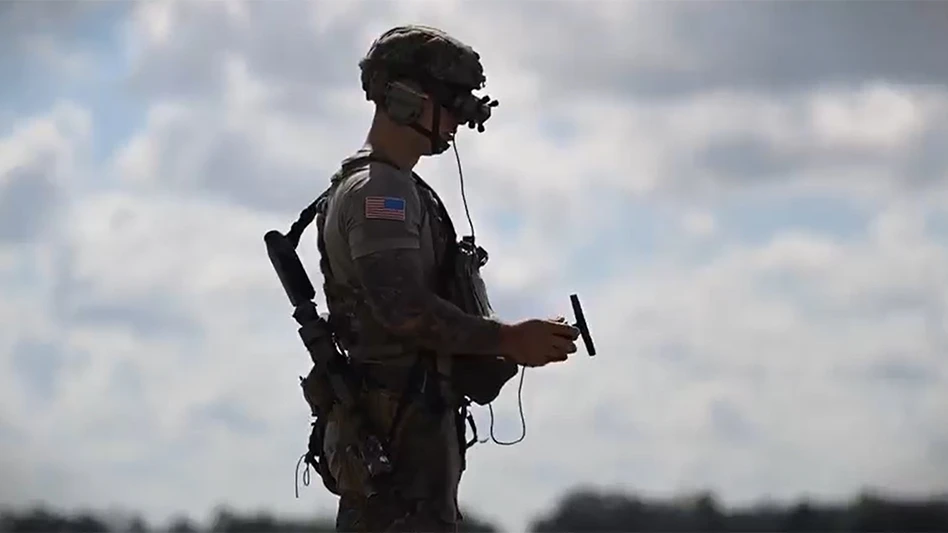
Auterion, the leading swarm prime, successfully executed a live-fire combat drone swarm strike at a U.S. military range in Florida. The operation was conducted by Airmen, Soldiers, Sailors, and Marines, and powered by Auterion and Kraken Kinetics at Camp Blanding, Florida. A single operator simultaneously commanded three autonomous strike drones to destroy three separate targets using Explosively Formed Penetrator (EFP) warheads.
This marks the first time a company has demonstrated a true one-to-many lethal strike in a live-fire environment with small attritable systems.
The test proved that a single warfighter can now deliver the kind of combat power previously reserved for entire formations. The demonstration was an early preview of the Department of War’s Swarm Forge program, to iteratively discover, test, and scale novel ways of fighting with and against AI - enabled capabilities – combining America's elite warfighting units with elite technology innovators.
“The one-pilot, one-drone model is obsolete,” says Lorenz Meier, founder and CEO of Auterion. “What we showed in Florida is that software now decides who brings mass to the fight. One soldier. Three targets. One coordinated strike.”
The end of the one-pilot, one-drone era
While traditional First Person View operations require a dedicated pilot for every munition, Auterion’s Skynode technology and Nemyx swarm engine enabled the operator to assign objectives and authorize lethal effects while the software autonomously handled navigation, formation control, deconfliction, and terminal guidance.
The combination of autonomous multi-target control with EFP warheads from Kraken Kinetics, designed to defeat heavy armor, signals a fundamental shift in infantry lethality. A small unit equipped with swarm-enabled systems can now halt mechanized formations that once required air support, artillery, or brigade-level assets.
“Autonomous mass isn’t about flying more drones,” Meier says. “It’s about collapsing the kill chain until decision-to-impact happens faster than the enemy can react. We have demonstrated that we can give American warfighters the edge.”
Key achievements of the Florida demonstration
- Force multiplication: A validated 1:N operator-to-target kill ratio, proving swarm tactics are operational, not theoretical.
- Precision lethality: Simultaneous EFP strikes on three independent targets under live-fire conditions.
- Joint service validation: Conducted on a U.S. military range with observers from across the Department of War.
This live-fire milestone builds on Auterion’s recent world-first multi-manufacturer swarm demonstration, where heterogeneous airframes were unified under a single operating system. The Florida test completes the equation by proving the lethal finish of the kill chain in a contested, operationally realistic environment.
“Every modern military is chasing force multipliers,” Meier says. “Today, we proved that autonomous swarms put that multiplier directly in the hands of the individual warfighter. This is how smaller forces defeat larger ones.”
Auterion has shipped over 30,000 Skynode Strike kits to Ukraine in support of Ukraine’s defense capabilities.
Latest from Defense and Munitions
- December 2025 U.S. cutting tool shipments totaled $215M
- Omni Defense Tech’s OTFD-100 Parachutist Flotation Device
- Defense and Munitions Online Exclusive - The parts room is a readiness problem, it's time to treat it like one
- NTMA survey finds manufacturing resilience, continued investment, and workforce pressures heading into 2026
- Steel Warehouse promotes Mike Beebe to Vice President of Corporate Sales
- Multi-sensor edge-to-cloud MatrixSpace AI software platform
- DMG MORI Federal Services awarded U.S. Department of Energy grant to advance laser additive manufacturing optimization with Oak Ridge National Laboratory
- Velo3D secures $32.6M Department of War contract to eliminate critical defense manufacturing bottleneck