AeroVironment
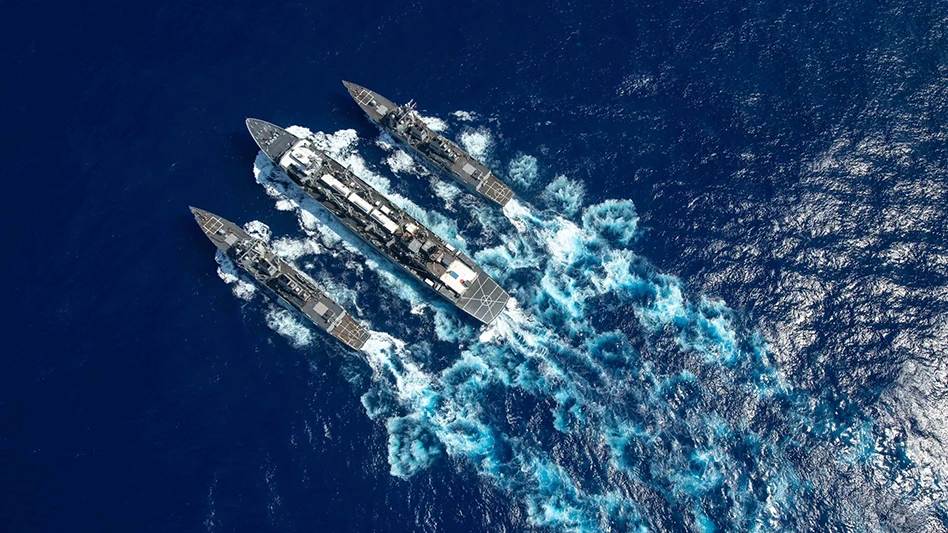
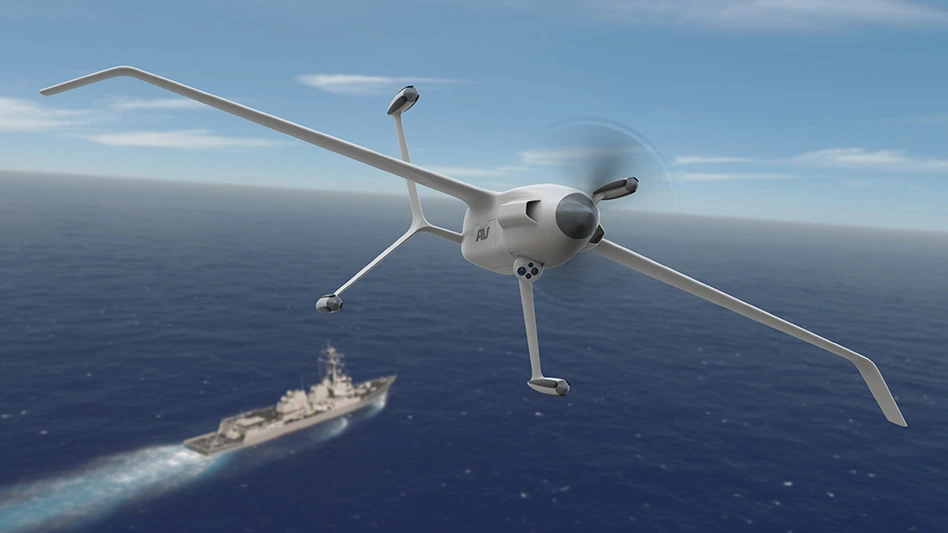
AeroVironment (AV) was selected by the Defense Advanced Research Projects Agency (DARPA) for continued development of its X-Plane design for the agency’s AdvaNced airCraft Infrastructure-Less Launch And RecoverY (ANCILLARY) program. AV’s offering – Wildcat – is a Group 3 vertical take-off and landing (VTOL) uncrewed aircraft system (UAS) developed specifically to execute ship-based operations in challenging maritime environments.
“We’ve prioritized controllability to ensure Wildcat meets the ‘anytime, anywhere’ goal of DARPA’s ANCILLARY program,” says AV’s Vice President of MacCready Works Chris Fisher. “Wildcat leans on autonomy to reduce operational burdens while enabling safe, infrastructure-less launch and recovery in challenging conditions from a range of Navy ships.”
Wildcat leverages AV’s SPOTR-Edge machine learning-enabled computer vision to enhance mission effectiveness. This capability builds on operational learnings AV has gained as a leader in the Group 1 to 3 UAS space with millions of operational flight hours on its Raven, Puma AE, and JUMP 20 uncrewed systems.
ANCILLARY calls for the development of a low-weight, large-payload, long-endurance VTOL UAS for missions executed by the U.S. Navy and Marines. AV’s Wildcat pushes beyond current Group 3 UAS offerings and provides expanded mission capabilities to address and overcome evolving threat landscapes.
Designed specifically for the ANCILLARY program, Wildcat meets DARPA’s objectives for a 450 nautical mile (nmi) mission radius and over 12 hours of endurance on station with 60 lbs of payload. Additionally, Wildcat exceeds program objectives for sea state recovery and cruise speed, with the ability to operate in high sea states and winds, and dash over 100 knots to quickly cover long distances over sea or land.
Wildcat’s large modular payload capacity will enhance mission responsiveness and flexibility, and its tail-sitter design requires fractional infrastructure and footprint compared to other offerings. It is designed to operate as part of a larger fleet of Wildcat UAS that leverage collision-avoidance and autonomy to deconflict airspace and collaborate to perform search missions in degraded or denied airspace.
“Our solutions are specifically crafted for the operator and Wildcat is no exception. AV has a strong history of seamlessly integrating our systems into a soldier’s daily operations and we look forward to further developing this design in partnership with DARPA and the Office of Naval Research for the ANCILLARY program,” continues Fisher.
Latest from Defense and Munitions
- SMW Autoblok Corporation appoints Brandon Mathis as National Sales Manager
- Bodycote expands U.S. aerospace and defense footprint with acquisition of Spectrum Thermal Processing
- AM Solutions’ automated surface finishing of 3D-printed parts
- Joint Interagency Task Force 401 expands counter-drone training
- Davie Defense awarded U.S. Coast Guard contract to build five Arctic Security Cutters
- Dillon Manufacturing’s Jaw Force Gauges
- Georgia Southern University partners with METAL to advance workforce training in metalworking and manufacturing
- AM General sells first HUMVEE Hawkeye 105mm mobile howitzer systems as part of three-year contract