Longshot Space Technologies
Editor's Note: This article originally appeared in the March 2026 print edition of Defense and Munitions under the headline “Hypersonics no longer a long shot.”

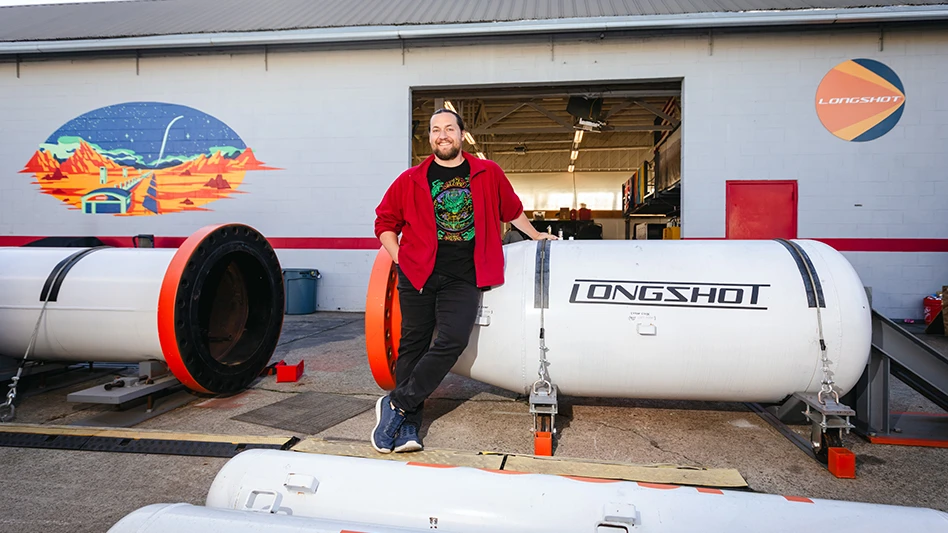
Many people started side projects during the COVID-19 lockdown whether it was knitting, painting, card collecting, or starting a business to launch projectiles at Mach 4 speeds. The last of those projects brings us to Oakland and greater Alameda County in California where Longshot Space Technologies CEO Mike Grace, an economist and former molecular biologist at the NASA Ames Research Center, is shifting operations from Oakland to a former U.S. Navy indoor cannon testing facility at Alameda Point. Longshot began in Grace's garage during the pandemic with COO Brendan Conaway, who lived in his neighborhood, and CTO Nathan Saichek, who would come over on the weekends, building a large multi-injection potato gun out of parts bought at a local hardware store. That potato gun caught the attention of the Air Force Research Labs (AFRL) and Silicon Valley as Longshot secured a Phase II Small Business Innovation Research (SBIR) contract and investments from big names in Silicon Valley to move from Grace's garage to a facility in Oakland to build a four injection, about 70ft-long, 6" interior diameter accelerator. AFRL wanted to find an affordable way to send 'big stuff at high speeds' into the atmosphere, according to Grace. The accelerator can shoot up to 1kg projectiles at Mach 4 speeds.
“That's three times faster than a 155mm howitzer in downtown Oakland, in a busy urban complex. We fired it 200 times at Mach 4 into basically an old, auctioned off safe packed with concrete, carpet, and sand,” Mark Bigham, vice president of defense programs for Longshot Space Technologies, says.
Instead of a howitzer giving off a traditional “boom” when fired, Longshot's accelerator gives off a series of “pops” down the length of the tube as compressed inert gases are ejected to chase the projectile moving at hypersonic and supersonic speeds to accelerate it through the end of the tube.
To expand their accelerator, Longshot needed to expand their space. Now in the former Navy facility, Longshot will be able to test 100kg projectiles at Mach 5 speeds through a 30" diameter tube stretching 120ft long. There's also a testing facility in Tonopah, Nevada in the works, which will allow Longshot to build a tube 40 modules long, about half a kilometer. The current facility in Oakland only features three modules.
“This bad boy, when it gets rocking, it's chucking 220 pounds, a 155-howitzer shell is 95 pounds so it's chucking two of them at Mach 5, which is three and a half times faster than a 155mm can actually fire,” Bigham says. “By using this very unique rear injection inert gas method, we're not talking about an explosion, we're talking about a popping burst letting gas go, and it accelerates to beyond Mach 5. And if you shrink the size down to about 45 pounds, we can go to Mach 7 with just compressed gas.”
Longshot is currently modifying the 6" gun using a technique called side injection that basically squeezes the projectile. On the back of the projectile, they put an arrow wedge, where the gas comes in from both sides and pinches it. They're using low-speed gas in testing but if Longshot switches to a high-speed gas such as hydrogen, the projectile could travel at up to Mach 17.

The accelerator's architecture dates back to World War II, but Grace and his team went to work improving the German-designed V3 cannon, which could only fire about 60 shots before the weapon was inoperable. The V3 was also about 400m long and had to go on the side of a hill so the projectiles could fire on an incline, making the V3 immobile, expensive, and a massive target for opposing military.
“America's getting to the point where we've kind of tried everything else, everything else is really expensive and really cool, I've made my career out of building really big, shiny, expensive, exquisite platforms, but we're at the point where that doesn't work anymore,” Bigham says. “So having an economist as a CEO who worries about the economics of it all of a sudden becomes important. Cost per shot matters a lot. The cost to fuel these systems matters a lot. The cost to manufacture them out of regular everyday oil and gas materials with regular blue collar dudes and dudettes who can build a mile and a half pipeline in a week – that all of a sudden matters, because now the calculus changes. Maybe 50% of my force is this fixed infrastructure, low cost, very affordable, that can chuck things halfway around the earth, and the other half are these mobile, very expensive systems but I can hide them. This mix and this complementary balance exist between these two things also, and it changes the balance.”
Unlike the V3, Longshot's accelerator lays flat and can lift the projectile into the sky because of its arrow wedge design. Grace describes it as boost glide architecture, because the boost isn't coming from a rocket like other projectiles.

“It's traveling in a vacuum inside of the tube, it hits the atmosphere, and it skips up like a stone,” Grace says. “You're building a hypersonic lifting body that would take stuff through the atmosphere, and you're basically trading some of your momentum for lift. You get up and out of the atmosphere. The vehicle is now at altitude, at speed, and you're a hypersonic wave rider. You cannot build a vehicle that can survive that transit through the lower atmosphere small. It won't work. You must have mass. This thing is going to be made of concrete. You have this vehicle, which is mostly heat shield and protection, carrying a payload that might be a ton to five tons way downrange.”
Grace envisions multiple accelerators set up at a site pointing in different directions to be used for interception of enemy attacks or to launch offensive strikes on enemies. The speeds and times achieved through Longshot's accelerator, if fired from a desert in Nevada, could intercept incoming enemy ballistic missiles for the West Coast before defenses in Hawaii or elsewhere in the Pacific could make a connection. The speed of fire would also allow quick defense if an enemy targeted the accelerator's site. On the offensive side, Longshot's projectiles can travel far enough, fast enough to deter a Chinese naval invasion of Taiwan for example. Longshot is currently working with several defense prime manufacturers to implement their ballistic payloads onto Longshot projectiles.
“Longshot is primarily transportation, the actual (ballistic payloads) in an offensive or defensive application need to be more technically sophisticated than our vehicle,” Grace says. “All our vehicle has to do is get up and navigate the atmosphere, like threading the needle, a bullet hitting a bullet in terms of an interception, or a vehicle coming to plunge in and smack a moving boat on the water.”
The Longshot team is waiting on approval to begin constructing their test facility in Nevada but once they get the okay from the Federal Aviation Administration (FAA) and Bureau of Land Management (BLM), Grace expects them to get their accelerator up and running in about six months. They’ll use house construction, oil & gas, and automotive materials in their accelerator thanks to Grace’s economist background.
“The single largest problem, the largest purchaser by far of aerospace products in the United States is the United States government, so producers price to basically extract the maximum they can get out of the United States government.”
— Mike Grace, CEO, Longshot Space Technologies
“The single largest problem, the largest purchaser by far of aerospace products in the United States is the United States government, so producers price to basically extract the maximum they can get out of the United States government,” Grace says. “The second problem is almost all the primes grew up in the context of the Cold War. They matured as organizations in the context of the Cold War. And in the context of the Cold War, spending more money was literally always the right answer. So, you have a market totally disconnected from the realities of price performance, because the U.S. government is effectively subsidizing it to an insane degree. So, if you're going to build something cool and you're touching aerospace in this country, you must build it yourself. You cannot work with the traditional suppliers.”
Also outside of traditional, the projectiles Longshot’s accelerator fires are made primarily of phenolic resin packed with carbon wrapped around wood, dust, and carbon fiber to act as a heat shield, along with aerospace aluminum and stainless steel. The combination is mixed in-house and then molded by employees who previously worked with resins while shaping surfboards. The cost-effective mix came to Grace after he broke down what a heat shield really needed to do in their accelerator.

“Heat shields are difficult for one of three reasons,” Grace says. “One, you're attempting to make something light and compact. Forget that. Two, you're attempting to make something reusable. Nothing is reusable at these speeds. And three, you're trying to make something you put a human being behind, I'll never fly a human being in our system. So, if you're prepared to sacrifice all three of those things, you actually have some really cheap options.”
With the Golden Dome initiative looking to invest approximately $50 billion in American hypersonics, the future is looking bright for Longshot as they hope to fully move into their new Alameda Point facility in the first half of 2026 and have test firings in the Nevada desert by the end of the year.
“I think we have a three-year run ahead of us, the United States Government is pouring money into hypersonics to try and get a solution to meaningfully deter China,” Grace says. “Year One, we get a big tube out in the desert. We're throwing vehicles. Year Two, we scale up in speed. We start going to Mach 15, not Mach 5, not Mach 7. Year Three, we have a vehicle. We have something going fast. We're going to altitude and actually turning into an effect downrange.”

Explore the March 2026 Issue
Check out more from this issue and find your next story to read.
Latest from Defense and Munitions
- Defense and Munitions Online Exclusive with Keeper Security
- Mazak will show shops how to drive production at Dallas open house event
- Sandvik Coromant's CoroTurn Plus turning adapter
- US Navy selects L3Harris Red Wolf for Precision Attack Strike Munition program
- Snowbird Technologies integrates Meltio Engine Blue into containerized hybrid manufacturing system for defense
- Precision Additive's PA-300 LPBF 3D metal printer
- BIG DAISHOWA supports future of manufacturing with Tools for Schools program
- Mission-Ready: Hutchinson Aerospace & Industry achieves CMMC Level 2 certification