Filling out a workforce is a hurdle the manufacturing industry has been trying to clear for decades as there were more than 400,000 job openings in manufacturing in 2025 according to the National Association of Manufacturers. Meanwhile, the U.S. Department of Labor reports between 3% and 4% of military veterans are unemployed, approximately 300,000 veterans.
Isembard, a UK-founded subcontract manufacturer with expanding U.S. operations focused on parts for hypersonic missiles, autonomous drone defense systems, and more, turned to Justin Baucum to lead its U.S. expansion from the Dallas–Fort Worth region. Baucum came to Isembard after serving in the U.S. Army as a Special Forces operator and never thought about a manufacturing career while serving.
“You see secondary effects of manufacturing but it’s not something I had given a ton of thought to until I came across Isembard and met the founder Alexander,” Baucum says. “We assume somebody else is doing something to fix it. I think the most in-depth perspective I had was watching one of those ‘How It's Made’ documentaries and now the dots have connected for me since participating here. I think back, there’s a product we’re making components for that will go directly to Special Operations units. This is my background so I’m able to see the advantages of this new technology and innovation because I had an old version of this product, and if I had this version, I'd be like, ‘Wow, this is incredible’ so it definitely connects full circle.”

Transitioning from the battlefield to the shop floor
Baucum believes several of the qualities he picked up in the military have helped ease his transition into the manufacturing industry, especially making a plan while maintaining agility, always having contingencies, then making a decision and moving forward. However, those are just some of the qualities Baucum believes translate from the military to manufacturing in the defense industrial base.
“There’s a big need for people to make things and I think the veteran population are trained to think ‘what needs to be done?’, and then ‘let me go do it’,” Baucum explains. “This hybrid between being able to do the machining, making metal, or setting up a business, but then also the ability to understand what it's more broadly associated with and what we're doing. Most people that join the military from my interactions have been like, ‘I want to be part of something bigger than myself, I want to be part of a team, doing something that’s important’. Talk about an industry that has basically the same thing.”

Connecting an eroding supply chain
Isembard and Baucum are now focusing on expanding their team in the United States as they look to bring in a dedicated software engineer and at least two more operators to help open new factories and complete site-specific jobs. Although Baucum is relatively new in the manufacturing industry, he’s been able to rely on Isembard’s leadership and established factories in the UK for direction as they look to open new factories and even add existing factories into the company through a franchise model. Isembard’s three UK factories consist of their flagship headquarters in London, a larger site that was converted to the Isembard brand, and a recently opened new build site. Baucum gathered experiences from all three sites and hopes to share them whether building a new factory, converting an existing factory, or expanding their U.S. headquarters. After serving in the military, Baucum believes being involved in the reindustrialization of the defense industrial base is the most patriotic mission someone can take on and that starts with eliminating the disconnect between established machine shops, start-ups, and government agencies.
“We're trying to provide a closer connection between these shops. I think there's an appetite for it,” Baucum says. “The primary mechanism for our business to grow is going to be via franchise. And historically, franchising and manufacturing haven't gone together. It's something that makes a lot of sense when you unpack some of the core things. If you look at any sort of graph of manufacturing capacity and demand, you'll see the downward trajectory of capacity for several reasons. Shops close up and a lot of cohorts in defense and aerospace industries are venture capital backed or privately funded. Our legacy businesses already consume the majority of the supply chain. Thinking back to the military, I recall waiting for certain pieces of hardware for six months, a year, sometimes longer. New companies competing with the legacy primes want to get their product in front of the Department of Defense, but they can't really afford that because their only advantage is speed, so there's really no supply to support those other shops. It's important we facilitate all these businesses with great products, especially in defense.”

Isembard hopes that facilitation picks up in the near future as Baucum lays out what he expects from his company and the defense manufacturing industry. In the next five years, Baucum wants to see 100 plus factories in the U.S. and a similar number in the UK, making a substantial impact on the capacity issue. Isembard will work with someone who has a 1,000ft2 garage with a couple machines or someone with 100,000ft2 and hundreds of machines.
“I think across our network, we start to see this big range of existing businesses convert in, but then also just range of capability,” Baucum says. “The idea being, a defense customer comes in and says, ‘Hey, we want this type of material with this very large part, and we want some sort of heat treatment or anodizing’, then we're kind of their one-stop shop within our network. The benefit to them is a single point of contact, having that network effect, not everybody has to have all the things, we can just route.”
Baucum also believes as reshoring the manufacturing industry increases, the amount of veterans getting involved in manufacturing will also increase.
“There seems to be a growing visibility or awareness of manufacturing, which is great. I think it's going to be one of the next waves of interest for a lot of people coming from other industries,” Baucum says. “I think you saw a lot from the military that went into private equity businesses and portfolio company operations. I think manufacturing hasn’t gotten a ton of attention, and so the more we can bring that to the forefront and say this is a viable option, the better. Whether you want to do more of the entrepreneurial ‘I want to start a factory, build a team,’ we can support that. Or, you want to join a company that's involved in this, here's a pathway to do it.”
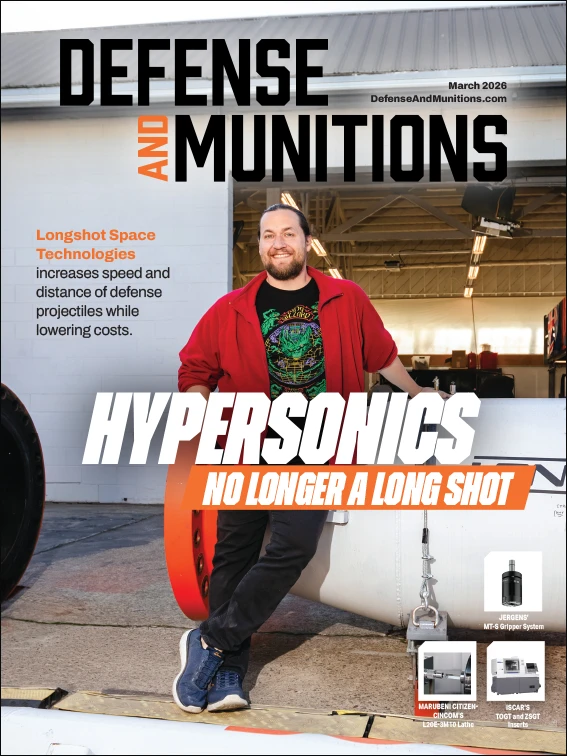
Explore the March 2026 Issue
Check out more from this issue and find your next story to read.
Latest from Defense and Munitions
- Defense and Munitions Online Exclusive with Keeper Security
- Mazak will show shops how to drive production at Dallas open house event
- Sandvik Coromant's CoroTurn Plus turning adapter
- US Navy selects L3Harris Red Wolf for Precision Attack Strike Munition program
- Snowbird Technologies integrates Meltio Engine Blue into containerized hybrid manufacturing system for defense
- Precision Additive's PA-300 LPBF 3D metal printer
- BIG DAISHOWA supports future of manufacturing with Tools for Schools program
- Mission-Ready: Hutchinson Aerospace & Industry achieves CMMC Level 2 certification