Editor's Note: This article originally appeared in the October 2025 print edition of Defense and Munitions under the headline “Solving thermal challenges with flexible heaters in UAV operations.”

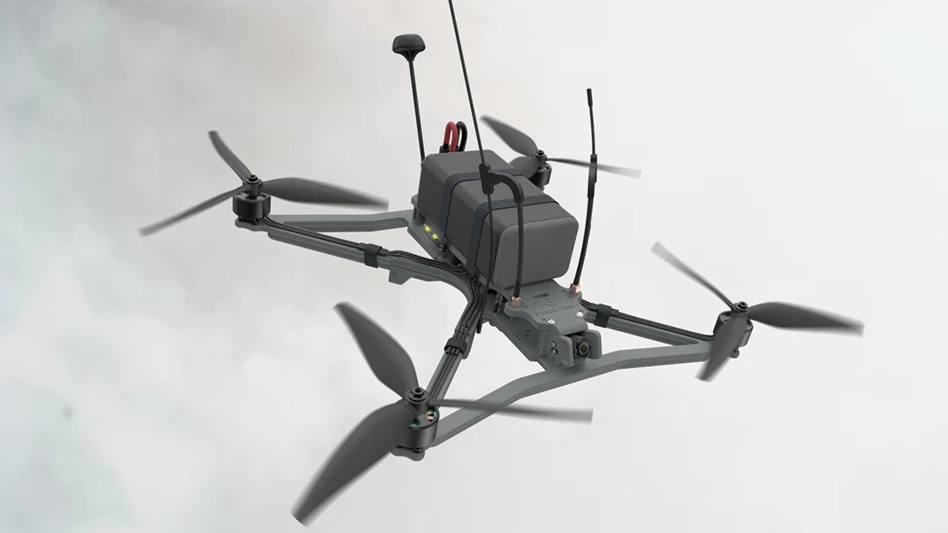
Unmanned aerial vehicles (UAVs) are increasingly being used in combat and non-combat missions. In July, the U.S. Department of Defense (DOD) stated they’ll be ramping up the production and fielding of drones to meet current military needs.
Defense manufacturers must ensure these UAVs remain reliable and operational, even in extreme environmental conditions. One critical part of managing extreme environments is thermal management, which is needed for performance and reliability.
Flexible heaters are the ideal solution to overcome environmental challenges in UAV design. They’re thin, lightweight, durable, and adaptable to nearly any geometry. They ensure systems continue to function optimally despite the challenges.
Understanding the environmental demands on UAVs

Military UAVs must operate unfailingly regardless of environmental conditions such as sub-zero temperatures, high altitudes, or humidity/fog. These conditions can have consequences for onboard systems.
At high altitude, or in cold weather regions, freezing temperatures can severely diminish battery power and lifespan. Ice build-up can affect mechanical parts such as rotors, blades, propellers, and actuators. Condensation caused by thermal cycling can wreak havoc on electronic components and cause haze or frost build-up in optics or camera systems. Lastly, cold weather can slow the response time of electronic components.
Any one of these issues can severely impact the ability of UAVs to carry out critical missions. In military situations, fast response, reliability, clear imagery, and consistent data collection are critical. Effective heating solutions are vital for the success of these tasks.
Flexible heaters are a tactical thermal solution

Flexible heaters, particularly those made from polyimide (Kapton), are uniquely suited for UAVs. They offer a low-mass, high-performance solution allowing UAV designers to:
- Extend operational range in cold climates
- Maintain reliability across electronics and sensors
- Deliver mission-critical payloads with mechanical dependability
- Improve image quality for surveillance and targeting
- Minimize reliance on expensive military-grade components by retrofitting thermal control
They also offer flexibility. Engineers can design them for the unique shapes and sizes of different UAV components while offering the adaptability to fine-tune performance without major system redesigns. Flexible heaters provide reliable performance while adding minimal weight.
Common applications in UAV systems
The integration of flexible heaters spans multiple UAV subsystems. Below we discuss the most common applications and why flexible heaters are the best option:
Battery warming - While often overlooked, batteries are one of the most sensitive components in a UAV. Since lithium-ion cells decrease in performance under 0°C, their efficiency and lifespan dramatically decrease in cold conditions. A flexible heater can stabilize the battery temperature in the optimal range of 15°C to 40°C, maintaining energy capacity and extending flight time.
However, using heaters in battery systems comes with its own challenges. The power source driving the heater is often the battery itself, which means careful design is needed to balance heater consumption with battery longevity. For lightweight UAVs, polyimide (Kapton) heaters are ideal because they’re thin, light, and efficient. In some niche cases, where chemical resistance from caustic battery acid is required, flexible butyl heaters may be the preferred option.
Optics and camera systems - Surveillance and monitoring cameras are indispensable for defense UAVs, especially those used for reconnaissance or intelligence gathering. However, lenses are prone to condensation, causing fogging (or even frost build-up) at high altitudes, during temperature shifts, or in humid areas. This can cause blurred images and condensation can corrode the components of those systems, potentially corrupting data and compromising the mission.
Flexible heaters are commonly applied around the lens housing to maintain a stable environment and a clearer view. The heaters don’t touch the lens itself but are mounted with adhesive backing around the surrounding enclosure. Heat is transferred via conduction, keeping the lens warm, reducing condensation and fogging.
Kapton heaters are outstanding in these applications because they’re easy to shape and install, and they offer temperature control without adding bulk. Acrylic adhesives are typically used to attach the heater, allowing for efficient but gentle heating to prevent fog or ice without distorting the optics. Additionally, these heaters can be customized to the geometry of optical components, so they don’t affect functionality.
Sensor, circuit, and electronic component heating - UAVs are packed with sensitive electronics such as GPS modules and control boards. In military usage, these systems must be able to work down to -40°C; however, many commercial-grade components aren’t capable of achieving those specs. Rather than increasing costs with custom hardware, designers often apply flexible heaters to these commercial components to maintain thermal stability.
This thermal stability prevents issues like solder joint cracking, condensation corrosion, and latency in displays or digital processing. Rather than heating individual components, flexible heaters are typically attached to the enclosure or housing. This approach distributes warmth evenly, reduces hotspots, and conserves power. Here again, polyimide heaters are preferred for their low mass and ability to conform to complex internal structures.
Actuator heating and mechanical movement - Actuators for components such as landing gear or payload mechanisms require lubricants to function smoothly. In cold weather, these lubricants can thicken, restricting movement or causing outright failure. Flexible heaters keep these lubricants at the proper viscosity, ensuring the actuators can perform reliably. This is especially relevant for UAV designers tackling diverse mission scenarios.
Customization and integration

The effectiveness of a flexible heater is different in each application, which is why customization is so important. Engineers must consider size and geometry, such as a flat battery pack or a curved lens housing. Also, the application can vastly alter the design (i.e., simple defogging vs. temperature control around control boards and critical circuitry). Customization is integral to ensuring heat is properly distributed without overloading the system or adding too much weight.
While polyimide is usually the go-to for lightweight applications, silicone and butyl flexible heaters are other options to consider depending on the chemicals the heaters are exposed to. Mounting strategies are also important, with adhesive being the lightest, and usually best, option in a UAV, but not always optimal depending on the application.
Another important consideration in thermal management is the power management system. Every watt of energy used for heating must be balanced with the rest of the drone functionality and the ultimate mission of the device.
Moving forward with innovation

Flexible heaters may be small, but their role in UAV operations under extreme conditions is critical. They can, quite literally, make or break a mission.
As defense manufacturers continue to innovate with UAV technology, and usage scenarios require higher altitudes, colder climates, and longer missions, the need for precise, efficient, and adaptable thermal solutions will continue to grow. Flexible heaters, with their lightweight construction and versatile applications, are poised to play a big role in this innovation.
Work with a knowledgeable partner
Birk Manufacturing has been designing and manufacturing thermal solutions with flexible heaters and temperature management for more than 35 years. Our innovative and experienced team has a deep understanding of the complexity of designing and manufacturing the highest quality products for mission critical applications.
Birk Manufacturing
https://birkmfg.com

Explore the October 2025 Issue
Check out more from this issue and find your next story to read.
Latest from Defense and Munitions
- Ransohoff hires Dennis Byrne as regional sales manager
- Sandvik Coromant's CoroDrill DE10
- #84 Manufacturing Matters - Defense Industry Trends with Greenwich Capital Group
- ZOLLER Technology Days & Smart Manufacturing Summit May 13-14, 2026 in Ann Arbor, Michigan
- Join the automation conversation
- America Makes announces two project calls worth more than $35M in funding
- Velo3D qualified as first additive manufacturing vendor for U.S. Army ground vehicles
- Enhanced visitor experience highlighted at TMTS 2026