ATI Inc.’s Additive Manufacturing Products (AMP) facility opened earlier this year in Margate, Florida, and while others in traditional manufacturing may see additive manufacturing (AM) as a threat, ATI is embracing the possibilities of printing parts to support the armed forces.
In a manufacturing landscape where the military needs parts faster to build or repair submarines, aircraft, carriers, and armored vehicles and get them into the field, AM and ATI specifically can fill that need even when it comes to large parts. The new 132,000ft2 facility can produce some of the tallest metal AM parts in the western hemisphere, up to 1.5m, in geometries previously not possible.
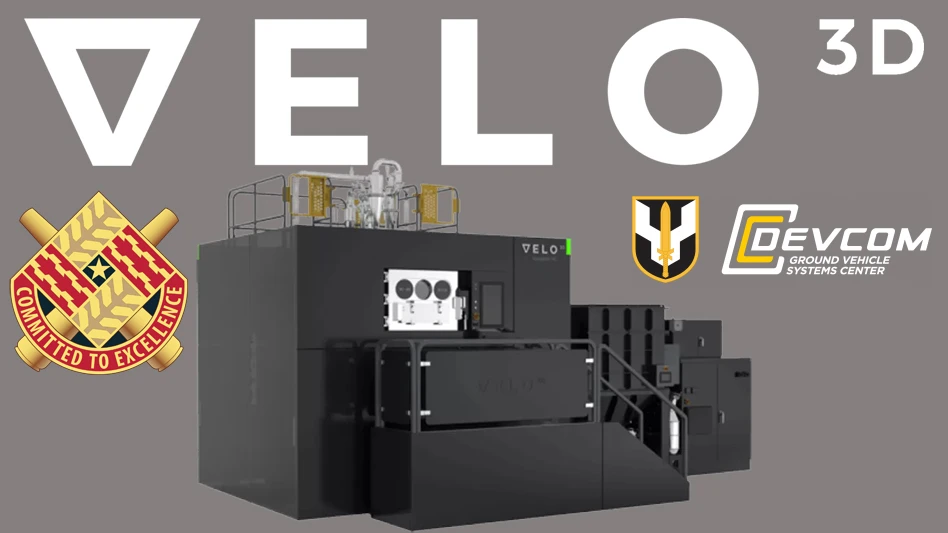
ATI’s ‘Printer Row’ contains AM machines with capabilities ranging from 12 high-powered lasers to single-laser machines. They use laser powder bed fusion, building layer by layer. All machines produce complex components for aero engines and airplanes, helicopters, submarines, spacecraft, hypersonic missiles, and more.

“The services want to use AM, and they’re trying to figure out where it makes sense. One of the reasons AM is challenging is when you put a part on an airplane or on a tank or in a submarine, and now people are riding in those vehicles, you want to make sure that part doesn’t fail,” Robert Patrick, senior director – ATI Defense says. “The Navy, to its credit, has embraced this. They’re exploring AM for all different types of submarine parts. But that doesn’t mean the Air Force and the Army aren’t going after it. AM allows you to advance technologically if you can’t make a part any other way than through additive manufacturing. For very complex parts, additive manufacturing is the most capable option. You can’t get this level of complexity by machining, casting, or forging. The only way you can make that part is by printing it additively.”
Materials and capabilities
ATI AMP is purpose-built to work with standard powder alloys such as Inconel 625, Ti64, and F6NM stainless steel along with ATI’s unique materials and made-for-additive advanced alloys such as ATI C103, Titan 23, and ATI 1700 Nickel. ATI offers a full powder-to-part solution where they can create a raw material powder for the customer and transform it into a part. The AMP facility also allows the military to consolidate the manufacturing process as ATI maintains design, printing, heat treating, and machining capabilities, along with scanning options such as laser, blue light, and CMM.
The consolidated manufacturing doesn’t just help new submarines, ships, aircraft, and vehicles reach the battlefield faster, it also keeps older versions on the battlefield longer.“It’s hard to get one part made because traditional manufacturing requires tooling,” says Joe Thompson, general manager of Additive Manufacturing Products at ATI Inc. “Then what happens when the vendor that made that one-off part goes out of business or gets sold 10 times? The tooling gets lost. So, the armed forces especially embrace the technology, because all they must keep track of is the printing file.”
Patrick, a U.S. Navy veteran, knows the difficulty of waiting for replacement parts in the field. While stationed at Naval Air Station Whidbey Island, Patrick had aircraft in his squadron grounded up to six months waiting for a replacement parts despite being only 80 miles away from the manufacturer.
“The beauty about additive manufacturing is you can print the individual part, and we’re doing that, but people are starting to design the whole build,” Patrick says. “You’re taking what in the past had been 10 parts, you combine them into one part, and now you’ve created a much more efficient, and I would argue, better defense weapon system because of the manufacturing.”
The first customer

Bechtel Plant Machinery Inc. (BPMI) awarded ATI its first contract to be produced at the new facility, for highly engineered part solutions in support of the U.S. Naval Nuclear Propulsion Program. It’s the first of hopefully many contracts for the new ATI facility as AMP was designed with expansion in mind.
“I think not only for additive manufacturing but the materials we make supporting additive manufacturing to support traditional aerospace and traditional tanks and things like this,” Thompson says. “I also think that’s fun when you’re in markets growing like this, and such an important piece to your country, there’s continued investment. We look at what the next five machines are we need to put in there? What new technology is going here?”
The U.S. and its allies aren’t the only armed forces looking at new technologies to advance their military capabilities so ATI and the team at AMP plan to step up and face a dynamic and uncertain global strategic environment.

“Countries want to defend themselves, and the weapons systems they procure have to be technologically advanced to meet the threat,” Patrick says. “Additive manufacturing is going to play an increasingly important role in meeting those technology threats. Everything is about weight, strength, temperature resistance, and speed. So if you must make something, you must use the best materials and the best manufacturing processes to allow customers in those countries to win or armor up so adversaries know they will lose.”
ATI Inc.
https://www.atimaterials.com

Explore the April/May 2025 Issue
Check out more from this issue and find your next story to read.
Latest from Defense and Munitions
- CERATIZIT shares insight into defense manufacturing
- Allen Control Systems wins U.S. Army’s xTechOverwatch competition for breakthrough in autonomous counter-drone systems
- MKS' Ophir BeamWatch AM-3 additive manufacturing beam analyzer
- Gilat receives more than $16 million order to supply SATCOM Systems to a European ministry of defense
- Ransohoff hires Dennis Byrne as regional sales manager
- Sandvik Coromant's CoroDrill DE10
- #84 Manufacturing Matters - Defense Industry Trends with Greenwich Capital Group
- ZOLLER Technology Days & Smart Manufacturing Summit May 13-14, 2026 in Ann Arbor, Michigan