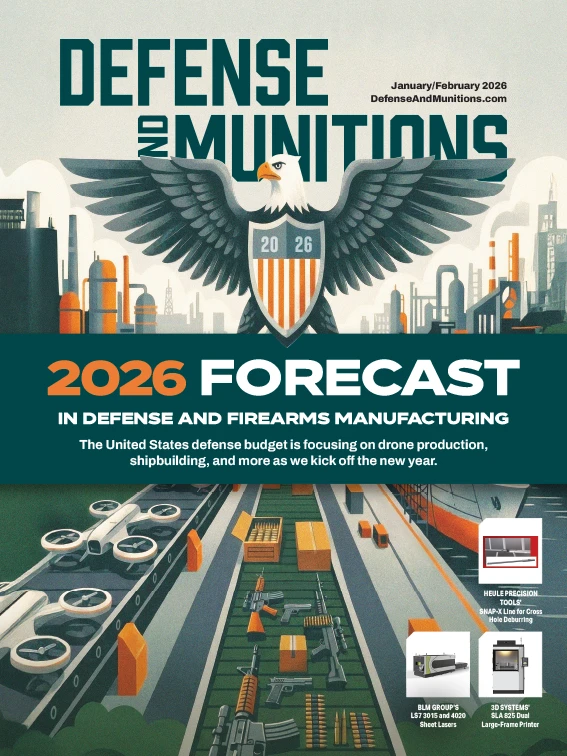
2026 forecast in defense and firearms manufacturing
2026 outlook for defense manufacturing highlights United States defense budget priorities, including drone production, shipbuilding, and industrial supply chain investments.
Many manufacturing industries have ebbs and flows which are tough to navigate. However, defense manufacturing never seems to slow down, there’s consistent government backing, many of the materials used in the manufacturing process are prioritized to the front of the supply chain, and there are billions of pieces and parts needing to be cut, drilled, milled, machined, and more. Defense spending is forecast to increase in the United States and shows no signs of slowing down going into 2026, so defense and munitions manufacturing will continue to be a priority. How much exactly will be spent and what it will be spent on are still questions that will have to be answered in the New Year, but I’ll forecast what to expect next in the U.S. and globally.
United States defense budget
The President’s FY ’26 National Defense Budget requests $1.01 trillion, a 13% increase from 2025. However, at the moment, Congress has passed $831.5 billion for the Department of War’s (DOW) discretionary budget. Outstanding budget considerations going through Congress could bring that final number up toward $893 billion.
The President’s Budget for 2026 includes $25 billion for Golden Dome, a comprehensive missile defense initiative addressing the most catastrophic threats facing the United States including ballistic, hypersonic, and cruise missiles, and other advanced aerial attacks.
Shipbuilding and naval expansion
The budget request includes funding for 19 new ships, 14 more than FY ’25, demonstrating our commitment to naval modernization. Significant investments across multiple vessel classes include two Virginia-class submarines for about $11 billion and one Columbia-class submarine, also $11 billion. The budget also includes $2.5 billion for nuclear shipyard productivity enhancements.
Munitions investment
The budget invests $6.5 billion in conventional and hypersonic munitions, increasing long range fires with the procurement of nearly 2,000 critical weapons. The ’26 budget also invests more than $3.9 billion in hypersonic weapons, restarting production of the Air Force’s successful Air Launched Rapid Response Weapon (ARRW) and supporting the Army’s fielding of the first operational Long Range Hypersonic Weapon Battery (LRHW) by the end of 2025.
Defense industrial investments
The budget includes an additional $1.3 billion for industrial-based supply chain improvements and an additional $2.5 billion for missiles and munitions production expansion. The budget also includes significant new investments of $200 million for automation and artificial intelligence (AI). It breaks down to shipbuilding, munitions and defense supply chains, and air and missile defense alone accounting for 50% of the total enhancements.
Unleashing American drone dominance
The United States and militaries across the world are turning to drones for an increasing number of operations to avoid putting their own troops in danger. In June, President Trump announced an executive order to “unleash American drone dominance.”
In Section 9 of the executive order, the President laid out plans to deliver more drones to U.S. warfighters, including updating the Defense Innovation Unit’s (DIU) Blue UAS List monthly, which eeps track of approved companies and vendors to use for U.S. military drone production. The executive order also says the Secretary of Defense shall coordinate with the Secretary of Transportation, acting through the Administrator of the FAA to streamline the approval processes to expand access to airspace for conducting unmanned aircraft systems (UAS) training. Finally, the order asks the Secretary of Defense to task the Secretary of each military department to identify programs that would be more cost efficient or lethal if replaced by UAS.
The global military drone market was valued at $15.23 billion in 2024 and is projected to grow from $15.8 billion in 2025 to $22.81 by 2030 at the compound annual growth rate (CAGR) of 7.6% according to MarketsandMarkets.
Global defense economy
Globally the United States spends more than the next 10 countries combined, with China coming in second place with $266 billion according to GlobalFirepower.com.
The world defense budget was estimated to be approximately $2.005 trillion in 2023 and is expected to reach approximately $2.547 trillion by 2028 at a CAGR of 4.90% according to MarketsandMarkets. Geopolitical tensions, regional conflicts, and addressing emerging challenges such as cyber warfare and terrorism are driving defense budget growth. Technological advancements and the race for military superiority have also fueled increased defense spending.
Global military spending
Technavio forecasts the land-based defense equipment market to increase by $34.12 billion at a CAGR of 8.4% between 2023 and 2028. The land-based defense equipment market is witnessing significant advancements, driven by the integration of technology into military applications.
Technavio also reports the ground-based aircraft and missile defense market is forecast to increase by $6.46 billion at a CAGR of 7.1% between 2024 and 2029. The market is experiencing significant growth due to the increasing demand for military supremacy and advanced military procurement. The development of new-generation air and missile defense systems is a major market driver, as these systems are essential for countering surface-to-air missiles, air-to-surface missiles, air-to-air missiles, and anti-ship missiles. The rising threat from unmanned aerial vehicles (UAVs) is also pushing nations to invest in advanced defense systems.
The global rocket and missile market is projected to increase from $62.50 billion in 2024 to $85.22 billion by 2029 at a CAGR of 6.4% according to MarketsandMarkets. The growth is driven by increasing defense programs with the objective of strengthening country security against threats.
The Insight Partners report the artillery systems market is projected to reach $20.98 billion by 2031 from $11.99 billion in 2023 at a CAGR of 7.2%. Rising deployment of self-propelled artillery systems is likely to bring in new trends in the market. Rising global military expenditure, increasing numbers of contracts for the supply of artillery systems, and rising deployment of self-propelled artillery systems by various armed forces worldwide are expected to drive the artillery.
Firearms market
The rifles market is forecast to increase $766.5 million at a CAGR of 3.5% between 2023 and 2028 according to Technavio. The market is witnessing significant growth due to increasing defense spending globally, leading to increased demand for advanced rifles from military and law enforcement agencies. The increasing demand for customized weapons is leading companies to invest in automation and advanced bullet loading technologies. The rise of terrorism and the subsequent need for advanced precision weapon systems have also increased focus on semi-automatic and automatic weapons.
The small arms market is projected to grow to $11.1 billion by 2027 at a CAGR of 4.5% according to MarketsandMarkets. Rising investments in the development of new and advanced firearms and ammunition along with modernization of small arms are driving factors for market growth. Handguns such as pistols and revolvers along with rifles such as assault rifles, sniper rifles, shotguns, and machine guns are witnessing heavy demand in North America, Europe, and the Middle East.
Small caliber ammunition market
The small caliber ammunition market size is projected to reach $13.19 billion by 2031 from $6.76 billion in 2023 at a CAGR of 8.7% according to The Insight Partners. Armed forces are focusing on caliber sizes such as 7.62mm for attaining greater projectile ranges, as the existing calibers such as 5.56mm are becoming ineffective in piercing tougher armors. Small caliber ammunition segmented into 5.56mm, 7.62mm, 9mm, 12.7mm, 14.5mm, 45ACP, .338mm, .22LR, .223 REM, .308 Winchester, and others with the 9mm holding a larger market share in 2023. The market is segmented into pistols, rifles, and shotguns with pistols holding a larger market share in 2023.
Firearms sales
SafeHome.org reports in the first four months of 2025, American gun dealers and individuals sold approximately 5.2 million guns, putting the year on pace for a projected 4% drop in sales compared to 2024. An estimated 16.1 million firearms were sold in the U.S. in 2024, a 3.4% decrease from 2023. In 2023, 16.7 million firearms were sold in the U.S., a 4% decline from 2022. Statista meanwhile reports since 2022, approximately 42% of American households own at least one firearm, which comes to 53.3 million households in the United States possessing one or more firearms.
New technologies
Additive Manufacturing Research reported the DOW spent $800 million on 3D printing/additive manufacturing (3DP/AM) in 2024, a 166% growth expected to maintain through the end of the decade, reaching $2.6 billion in 2030. Escalating and evolving global tension and security challenges position the 3DP/AM industry as crucial for defense and military entities to conceptualize, develop, and deploy critical assets and equipment quickly.
“ROSS Mixers expects defense and munitions manufacturing will continue to grow in 2026 due to increased government investment, federal incentives, and the rising demand for process equipment made in the United States. Since 1842, ROSS Mixers has led the way in producing machinery for mixing, blending, drying, dispersion, and control systems. Nearly two centuries of experience now support defense and munition manufacturers in producing mission-critical components for propellants, explosives, adhesives, sealants, coatings, and advanced composite materials with the consistency and quality required for demanding processes.
In 2026, the U.S. Defense budget’s top priorities will include procurement, munitions stockpiling, the modernization of domestic manufacturing facilities, as well as robust research and development advancements. This agenda along with the federal incentives introduced in the One Big Beautiful Bill Act encourage manufacturers to invest in purpose-built, high-quality equipment capable of consistent performance, automation integration, and continuous operation. Provisions such as 100% equipment expensing, expanded Section 179 deductions, permanent bonus depreciation, and advanced manufacturing investment credits will improve cash flow and shorten historically lengthy return-on-investment timelines.
Additionally, ongoing conflicts in Ukraine, the Middle East, the Caribbean, and continued global security uncertainty are highlighting the growing need for long term U.S. defense readiness and strong domestic supply chains. ROSS Mixers is uniquely positioned to support defense and munitions suppliers in meeting these challenges with a team of in-house engineers and fabricators based in five U.S. plants: two in New York, two in Georgia, and one in Florida. This large domestic footprint supports a range of specialized equipment, including double planetary, multi-shaft, and high-shear mixers, as well as integrated ROSS SysCon control systems which meet strict safety requirements, are engineered to be used in hazardous environments and provide consistent, highly repeatable process results.
Looking ahead, continued growth in defense manufacturing will rely on close collaboration between producers and equipment suppliers who understand the technical and operational realities and challenges. Through long-term partnerships and U.S.-based engineering and manufacturing, ROSS Mixers is prepared to support defense and munitions manufacturing customers as process requirements, safety standards, and production needs change.”
Andy Middleton, Senior Vice President–Europe, Middle East and Africa for UltiMaker
“UltiMaker, based in the Netherlands, designs, manufactures, and assembles 3D printing software and hardware, 100% ourselves. Our history is as one of the pioneers of the whole market. The company went from ‘Oh god, this is useless. It's just for the geeks, the nerds’ to today, UltiMaker has a quarter of a million printers, across the geeks and the nerds for sure, but also automotive, industrial, defense, and manufacturing. What's the future of UltiMaker? UltiMaker will move up the market. We'll focus on three segments with different requirements: education, manufacturing, and defense. In defense, you need high-quality, high-grade engineering plastics, even higher than we have today. Manufacturing on demand, printing of spare parts. We're going much further into defense. We'll be bringing out new hardware products, bigger hardware products, and we'll be bringing out, in collaboration with third parties, high-end materials which are printable on affordable printers.”
Kevin Matthies, President of Global Hardware, Incora“The global defense industry is positioned for another year of expansion and innovation. The United States will remain the world’s largest single defense market, but international growth, especially across Europe and Asia-Pacific, will define the next phase of opportunity for suppliers and policymakers alike. The industry’s focus is clear: invest in advanced technology, and prioritize supply chain resilience to meet rising global demand with timelines intact.
In North America, elevated budgets will sustain momentum across missiles and defense, space systems, artificial intelligence (AI)-enabled platforms, and munitions replenishment. Yet persistent workforce shortages, cost inflation, and supply chain bottlenecks will continue to pressure timelines.
Across Europe, spending and procurement will gather pace, driven by NATO commitments and national budget increases, especially in Nordic and Baltic states. Joint procurement efforts through the EU are fueling industrial autonomy and creating strong order books for regional primes. Air defense, naval systems, ammunition, and interoperable command-and-control solutions will remain top priorities, though industrial constraints around semiconductors and munitions output pose challenges.
In Asia-Pacific, single-digit growth will continue as nations double down on indigenous capabilities and sustainment. China remains the largest spender, but Japan, South Korea, Australia, and Taiwan are all expanding investment in missiles, air and sea defense, and Intelligence, Surveillance, and Reconnaissance (ISR) systems to address geopolitical tensions and strengthen deterrence.
The Middle East and North Africa will maintain high procurement activity in 2026, albeit at a moderated pace. Air platforms, missile-defense, and sustainment contracts will dominate, while Gulf states increasingly prioritize local production and long-term partnerships.
Elsewhere, Africa and Latin America will see modest but targeted growth, with select states investing in lighter platforms, ISR, and naval modernization programs.
Overall, 2026 will be marked by both opportunity and constraint. Demand is strong and broad-based, but resilience – industrial, financial, and geopolitical – will determine which nations and suppliers can truly keep pace with the defense sector’s accelerating evolution.”
The defense industry in the United States continues to rise and while less support will be going toward global conflicts, defense, firearms, and munitions manufacturers can expect to stay busy in 2026 and the coming years replenishing the stockpiles of weapons, munitions, armored vehicles, ships, submarines, and more. Also, personal protection in the United States is gaining interest so civilian firearms sales will allow gun manufacturers to keep producing pistols, rifles, shotguns, and any other firearms, ammunition, and accessories customers might want. D&M